In our experience, how to move to Spain comes down to three questions. Can you move? How will you move? And, how do you make the most of your life once you are here? This guide answers them in that order, using the same framework we use with every client: Decide, Relocate, Thrive.
Moving to Spain means confirming which visa lets you legally live here, settling your tax position and healthcare cover before you arrive, then choosing where to live, applying, and registering as a resident once you land. These are the 9 steps in the order they need to happen.
- Confirm your visa route. How can you legally live in Spain? The Non-Lucrative Visa for retirees and passive income, the Digital Nomad Visa for remote workers, or a work or student visa. EU, EEA and Swiss citizens need no visa at all.
- Check you meet the income requirement. Every route has a threshold, and it is a floor rather than a budget.
- Get health insurance that qualifies. A policy has to meet seven specific criteria or the visa application is refused.
- Settle your tax position. How much Spanish tax will you pay, and what has to happen before you arrive rather than after?
- Choose where to live. Climate, city size, schools and connections, and the tax consequences of the region you pick.
- Gather your documents. Criminal record check with apostille, medical certificate, proof of income, sworn translations, and any other documents your visa or residency requires.
- Find a home. We recommend most clients rent before they buy. Figure out what you need and how seasonal changes matter.
- Dive into the administration. Get your NIE, register for your padrón, then your TIE residency card. Open a bank account and setup utilities. For those that need it, apply to schools and find work.
- Thrive. Enjoy everything that Spain has to offer.
Everything on this page comes out of more than 700 full relocations managed since 2017, for clients from over 40 countries.
Stage 1: Decide >> Can I move to Spain?
Moving to Spain is achievable for many people across a range of life stages. Three answers decide whether it works for you: your visa route, your tax position, and your healthcare cover. They interact. Your visa route sets your income threshold and shapes your tax position. Your healthcare cover can stop the visa application outright. Your tax position can change where in Spain it makes sense to live. Get one wrong and it can unravel the others.
Do you need a visa to move to Spain?
Yes, if you hold a non-EU passport and plan to stay longer than 90 days. No, if you hold an EU, EEA or Swiss passport, although you still have to register as a resident once you arrive.
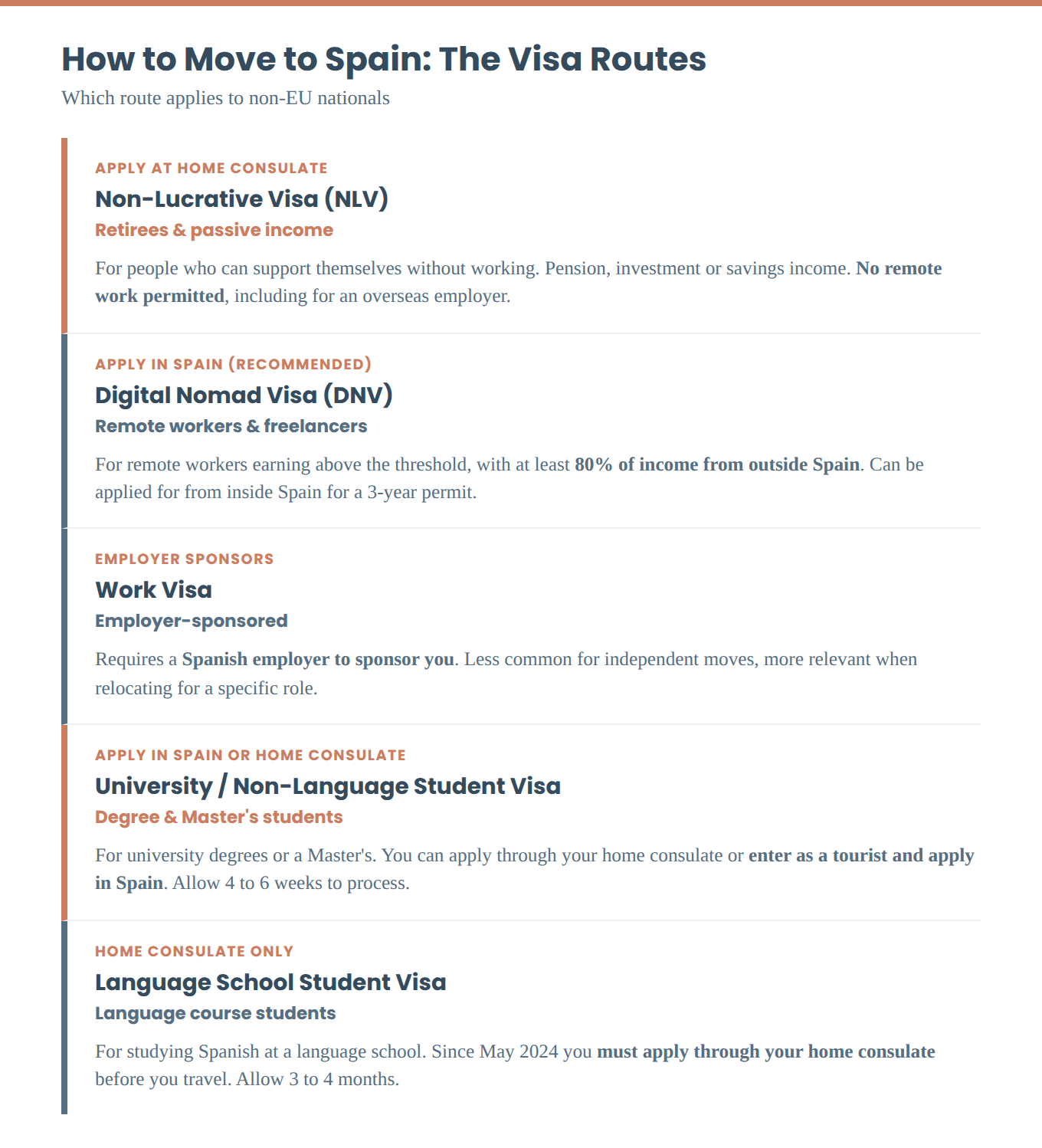
For non-EU nationals, five routes cover almost everyone.
- Non-Lucrative Visa (NLV). For people who can support themselves without working: retirees, people with investment income, anyone living on savings or a pension. It permits no work of any kind, including remote work for an overseas employer. Applied for through your home consulate only, valid one year initially and renewable in two-year blocks.
- Digital Nomad Visa (DNV). For remote workers and freelancers, with at least 80% of income from clients or an employer outside Spain. Can be applied for from inside Spain, which yields a three-year permit rather than the one year a consulate application gives.
- Work Visa or Highly Qualified Visa. Requires a Spanish employer to sponsor you. Relevant if you are relocating for a specific role rather than making an independent move.
- Student visa. There are two streams for this visa.
- For degree and post-graduate study. Can be applied for from inside Spain or through your consulate.
- For studying Spanish at a language school. Consulate only since the rules changed in May 2024.
The biggest mistake we find is people who think they can still work on a non-lucrative visa. If you intend to keep your remote job or work in Spain after you arrive, the NLV is not your route.
For a full comparison of all visa routes, including student visas and work permits, see our Spain visa types guide. Most people are choosing between the first two, and we’ve compared the NLV and DNV in detail if that’s your decision. Not sure which route applies to your situation? Our expert immigration partner offers a 30-minute consultation tailored to your specific circumstances.
What Health Insurance do you need to move to Spain?
Non-EU nationals applying for a Spanish visa need private health insurance meeting seven specific criteria: no co-payments, no coverage exclusions, unlimited coverage, repatriation included, licensed in Spain, no waiting periods, and valid for the full period of your stay. Miss one and the application is refused.
Beyond that it depends where you are coming from. Most non-EU nationals moving on a visa need qualifying private health insurance as a legal condition of the application. EU citizens working or self-employed in Spain access the public system through social security contributions, while non-working EU residents need private cover to demonstrate self-sufficiency. UK citizens with an S1 form can use that instead of a private policy.
Whatever your route, the private system here is good, the cost is far lower than most people expect, and the level of care you get is a world-class.
What must your health insurance policy cover?
For a visa application, the policy must satisfy all seven. Miss one and the application is refused.
- No co-payments. You cannot be charged per visit or per treatment.
- No coverage exclusions. Conditions cannot be carved out of the policy.
- Unlimited coverage. No annual or lifetime cap.
- Repatriation included.
- Licensed in Spain. The insurer must be authorized to operate here.
- No waiting periods. Cover has to be active from day one.
- Valid for the full period of your stay.
Policies designed for local residents routinely fail on co-payments or waiting periods, which is why a policy that works perfectly well for a Spanish family can still sink a visa application.
For the full breakdown, see our guide to Spanish health insurance for residency and visas.
How much does private health insurance cost in Spain?
For Americans the pricing is a consistent shock, in the right direction. Alastair and Alison, both in their early 50s, pay around €1,800 a year for full family cover including their 18-year-old son, from a top Expat insurer. When we send Americans quotes they routinely ask whether the figure is monthly. It is annual.
“When we arrived, we didn’t have coverage before our DNV application, and I had a frightening visit to the emergency room. Two nights in hospital. Saw the doctor twice. IV with steroids and antibiotics, oxygen, and breathing treatment. The total bill was 750 euros. We were expecting 10,000 easily.”
Rhys, American Expat living in Valencia, arrived October 2024
Will a pre-existing condition affect your policy?
Your pre-existing conditions are assessed individually by each insurer’s medical department. There is no blanket rule. Mild or well-managed conditions, such as controlled blood pressure, minor vision issues or a stable thyroid condition, are regularly included with no effect on the premium. For more complex histories, insurers may offer a policy with a premium loading or a specific exclusion.
This is where it matters for the visa. An exclusion that breaks one of the seven criteria means a refused application. Navigating it means shopping across multiple insurers rather than accepting the first offer, and for almost everyone we work with a qualifying, unexcluded policy exists. Alastair has glaucoma. It is included in his policy with no loading, and it changes nothing about the cost or the visa.
For the more details, see our guide to Spanish health insurance with pre-existing conditions.
Can you use Spain’s public healthcare?
Not at the visa application stage, which is why private cover is a legal requirement. Once you are resident and contributing to social security, or you hold an S1, then you may be able to. Spain’s public healthcare is excellent and emergency care is exceptional. The limitations are specific: longer waits for non-urgent specialists, no choice of doctor, and in regions with their own language your GP may not speak Castilian Spanish or English. Alastair’s Spanish is good but does not stretch to complex medical conversations, which is why he keeps private cover even after qualifying for public healthcare.
For how the system works at each stage, including the S1 route for UK citizens, see healthcare in Spain.
What do you need to know about tax before you move to Spain?
Tax is a show stopper for some people, but in most cases it does not have to be. The question is how do you move to Spain and pay a reasonable level of tax. There are four things to get right, and every one of them is easier before you arrive than after.
- Work when you will become a Spanish tax resident.
- Understand how tax residency impacts transactions, capital gains, and income and act at the right time.
- Take cross-border advice six to twelve months out rather than once you are here.
- Understand how where you live in Spain impacts your tax liability.
Tax is the decision with the highest cost if you get it wrong, and the one most people leave until last. Once you are here and have crossed the thresholds, most of it cannot be undone.
Spain treats things like join filings, family trusts, pensions income, capital gains allowances and many things very different from the US and other countries. There are different taxes, allowances, and structures you must understnad.
Alex Ibañez, our specialist tax partner, puts it in one line: “Doing things in advance is always the best advice.”
When do you become a Spanish tax resident?
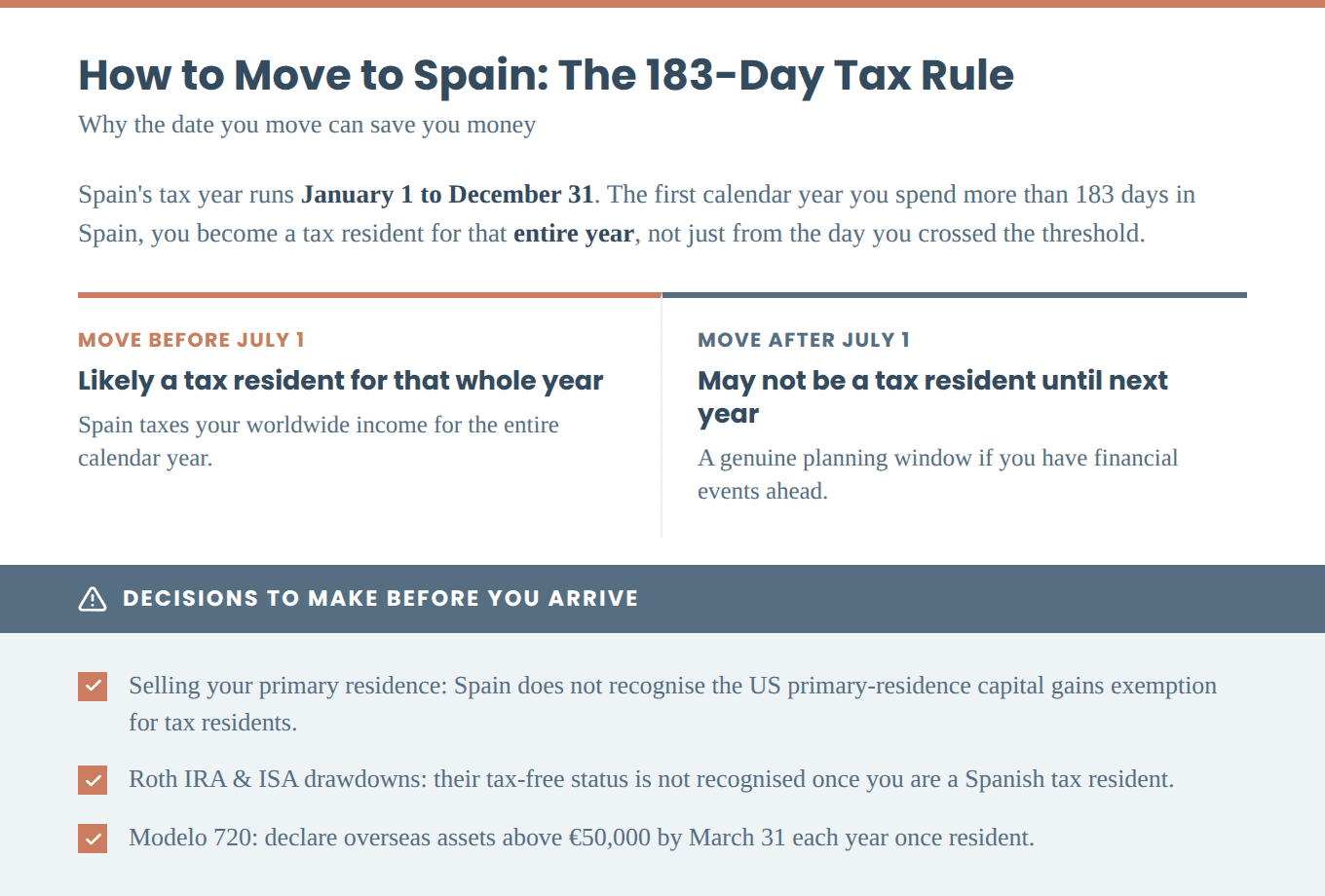
Spain taxes your worldwide income for the whole of any calendar year in which you spend more than 183 days in Spain. Not from the day you crossed the threshold. The entire year, retroactively.
The Spanish tax year runs 1 January to 31 December. Move before 1 July and you will probably be a tax resident for that year. Move after 1 July and you may not be until the following one. That gap is a planning window, and for anyone with a significant financial event ahead it can be worth a great deal.
“Spain is unique. Even if you reach 183 days by December of a specific year, you become a tax resident for the whole year. Choosing the timing of your move is genuinely consequential.”
Ricardo Jesus, Moving to Spain financial advisor partner, speaking at the MTS Americans Moving to Spain webinar
Legal resident and tax resident are not the same thing
Legal residency is your immigration status. It is determined by your visa or registration: your Non-Lucrative Visa, your Digital Nomad Visa, or your EU resident certificate. It gives you the right to live in Spain. Tax residency is a separate determination made by the Spanish tax authority, based primarily on how many days you spend in Spain in a calendar year, not on whether you have a visa or have registered.
You can be a legal resident without being a tax resident yet. For example, if you arrive late in the year and spend fewer than 183 days in Spain before December 31. For practical purposes, most NLV holders become Spanish tax residents from their second year at the latest, because the NLV renewal requirement means spending more than six months a year in Spain. From that point, Spain taxes your worldwide income.
For a full explanation of how the Spanish tax system works, including filing dates and the main tax categories, see our Spanish tax system guide.
The decisions that need to happen before you arrive
Three situations where timing relative to Spanish tax residency is critical.
- Selling your primary residence: In the US, the primary residence exemption means most people pay no capital gains on the sale of their home. Spain does not recognize that exemption for Spanish tax residents. MJ, who moved her family to Asturias, pushed her move date back past July 1 specifically to avoid this. Ricardo Jesus described a client who moved to Barcelona early in the year, took IRA distributions, had assets over $3 million, and, mid-conversation, realized he might have to go back to the US because no one had modeled the Spanish tax liability before he moved.
- Roth IRA and tax-advantaged accounts: Spain does not recognize the Roth IRA’s tax-free status. Once you are a Spanish tax resident, withdrawals from a Roth are taxed as ordinary income. The window to convert or draw down is before you cross the 183-day threshold in your first year. The same logic applies to ISAs for UK residents: Spain does not recognize the ISA’s tax-free status. If you hold a significant ISA or a SIPP (self-invested personal pension), take advice before you become a Spanish tax resident on how distributions and growth will be treated.
- Maintaining your US financial accounts: do not close or restructure your US accounts before you move. There is no Spanish equivalent of a 401 (k) or an IRA, and Spanish investment products do not benefit Americans under US tax law.
For information on the interaction between the US and Spanish tax systems, including FATCA and FBAR obligations, see our guide to US Expat taxes in Spain. For how Spain taxes pensions and Social Security specifically, see how Spain taxes social security and pensions.
Wealth tax and why where you live matters
Spain levies an annual tax on your total worldwide net assets. Madrid, Andalusia, Cantabria, Murcia, La Rioja, and Extremadura offer a 100% rebate, effectively zero wealth tax. Catalonia and Valencia apply the full rate above relatively low thresholds. If your net assets are above €1 million, where you live in Spain is a tax input, not just a lifestyle choice. Our Spain regional tax comparison sets out the differences across all 17 communities. For wealth tax specifically, see our dedicated wealth tax guide.
The three answers above apply to everyone. Which visa, which documents, which treaty, which consulate and which timeline all depend on where you are coming from.
How do Americans move to Spain?
Americans are 51% of MTS clients, our largest single group, and the process carries enough US-specific detail that we keep a separate guide for Americans moving to Spain. US citizens face citizenship-based taxation, so you keep filing US returns wherever you live. Alex Ibañez describes the US treaty as one of the most complicated any country has, and the American side of a cross-border position as the part needing the most careful analysis. The NLV and DNV are the primary routes, and neither is straightforward without understanding the financial planning first.
For visa options, income requirements, the retirement account questions, healthcare, where Americans tend to settle and the full pre-departure timeline, read our complete guide to moving to Spain from the US.
If you are considering Spain as your next residence, Moving to Spain is the absolute best resource you could find as an American…All the services I have utilized from the tax specialist, the financial planner, to the immigration attorneys have been outstanding. They have diligently answered all my questions (and continue to address my inquiries as questions arise). They have been exceptional in their professionalism and welcoming no matter the issues addressed. Don’t hesitate! Moving to Spain will answer your questions, provide a wealth of resources, and keep you excited about life in a culturally rich and beautiful country. – María de los Angeles Crummett
How do British citizens move to Spain after Brexit?
British citizens are 23% of MTS clients, and we keep a dedicated guide to moving to Spain from the UK after Brexit. Since Brexit, UK nationals have no free movement rights and need a visa for stays over 90 days. The NLV and DNV are the primary routes. UK retirees receiving a State Pension or certain other government pensions may qualify for an S1 form, which transfers NHS entitlement to Spain and can satisfy the insurance requirement in place of a private policy. The UK-Spain treaty prevents double taxation, and many UK pensions are fully taxable in Spain once you are tax resident. The April to April UK tax year also creates a mismatch against Spain’s calendar year that sometimes has to be corrected the following year.
For the full post-Brexit picture, read moving to Spain from the UK.
How do EU, EEA and Swiss citizens move to Spain?
You can move without a visa. Free movement is a right of entry, not automatic residency. Stay longer than three months and you must register as a resident, and non-working EU citizens need to show self-sufficiency through private health insurance and sufficient funds.
“European citizens enjoy free movement rights within the EU, which means you can choose to live in any European country. It is not an automatic right of residence. The requirement is that you prove you can support yourself, or that you are coming to Spain to work.”
Raquel Moreno LLB, MTS immigration partner
Irish citizens hold EU passports and follow this route. For the registration process, self-sufficiency requirements and the family member route, read our complete guide for EU citizens.
How do Canadians, Australians and other non-EU nationals move to Spain?
The same framework as Americans: NLV for passive income, DNV for remote work, work visa with a Spanish employer. The treaty position differs by country, and Australians should note the July to June tax year creates the same kind of mismatch UK arrivals face. For the major immigration pathways, your nationality matters less that, for example, it does for taxation. So, standard NLV, DNV, work permit, and student visa processes apply with minor variations to most non-EU nationalities.
Know you can move. Know what comes next. Know what it costs.
Most people reach this point knowing far more than they did and still not certain whether they can actually go. That is the gap the Decide Package closes.
It answers all three questions in one process. An immigration consultation with our expert immigration partner, an hour of cross-border tax planning, healthcare quotes and a review of your options, then a Next Step Call with your relocation coach who brings it together and sends you a custom relocation quote. It includes three months of MtS Membership, and if you go on to a full relocation, those consultations are credited so you never pay twice.
You leave knowing whether you can move, what it will cost, and what your next step is.
Since 2017 we have managed more than 700 full relocations and helped thousands more with individual services, for clients in more than 40 countries, with a 4.9-star Google rating from verified clients.
Not ready for that? Take the 60-second stage quiz or get the free Moving to Spain Roadmap.
Stage 2: Relocate >>Where and how will I move to Spain?
You know you can move. Now the decisions change character. Where in Spain, what it costs, how long it takes, and the order the paperwork has to happen in.
Where should you live in Spain?
There is no typical choice. MTS clients have settled in capital cities and in villages, on both coasts and well inland: Madrid and Barcelona, Sitges and Girona, Málaga and Marbella, Villajoyosa, Altea and Calpe on the Costa Blanca, island life in Palma and Las Palmas, and the green north where almost nobody starts out looking.
The six areas below are where most people begin, not because they are the only answers but because between them they cover the trade-offs everyone is choosing across. Valencia for city life at lower cost, Madrid for infrastructure and schools, Málaga for climate and a slower pace, Alicante and the Costa Blanca for low costs and a large Expat community, Barcelona for urban sophistication, and the green north for value and a different Spain entirely.
The most common mistake people make when choosing a location is basing their choice on a holiday.
When you are on vacation, you are in vacation mode. Expenses feel different; you are not doing school drop-off, paying bills, or grocery shopping. The beach town that feels magical in July can feel completely abandoned by November. Amanda Chigbrow, MTS Client Care and Sales Lead, American Expat in Valencia since 2021
A scouting trip fixes this. Not a holiday. A trip where you walk a city asking whether you could live there, in the season you would actually live there. Amanda’s advice: if Madrid appeals, go in winter and find out how cold it gets. If you are drawn south, go in July and find out what 38 degrees means.
The questions worth asking are ordinary ones. What does a Tuesday look like in this life? How often will you fly home, and from where? How much Spanish do you want to use daily? Do you want a large Expat community, or to integrate more deeply into Spanish life? The answers narrow things fast.
Valencia: Best for City Life, Cost, and Community
The most popular destination among MTS clients. Around 800,000 people, big enough for international infrastructure, small enough to feel neighborly. Walkable, strong public transport, mild climate, established international community. Rhys and Shannon, who arrived from Atlanta in October 2024, describe the cost of living as enabling in a way they had not expected.
Madrid: Best for Infrastructure, Schools, and Professional Life
A capital in every sense. No beach, colder winters than people expect, higher costs than Valencia or Málaga. In return: unmatched cultural and professional infrastructure, strong international schools including British and American curricula, and the best connectivity in Spain. Madrid also has effectively zero wealth tax.
Málaga: Best for Climate, Coastline, and a Slower Pace
Carin Cowell, who has been in and out of Spain since 2012 and settled in Málaga three years ago, describes a city that was not on the radar as an Expat destination a decade ago and has since risen fast. Cosmopolitan without being overwhelming, international without losing its Spanish character. Sean Miller, a New Zealander of five and a half years, puts the coldest daytime temperatures around 12 degrees and, coming from Zurich, does not consider it winter at all.
Alicante and the Costa Blanca: Best for Lower Costs and an Established Expat Community
Suits people wanting lower costs, a slower pace and a large English-speaking community. Less cosmopolitan than Valencia or Málaga, which for many people is the point.
Barcelona: Best for Urban Sophistication
The most sophisticated urban environment in Spain, and the highest cost of living outside central Madrid. One thing to understand first: Catalan is the primary language in daily life, in schools and in government. Alastair Johnson, ten years in Barcelona, was not aware on arrival that a separate language was spoken where they lived. If you are moving with school-age children into the public system, the language of instruction in Catalonia is Catalan.
The North, Asturias, Galicia and Cantabria: Best for Nature, Value, and a Different Kind of Spain
Green, cool and significantly cheaper than the coast. MJ, an American who relocated to Asturias with her family on a DNV, chose it by filtering first for schools and then for climate. Not the obvious choice. It worked.
For a detailed breakdown of each region, including reasons to avoid as well as choose, see our full guide to where to live in Spain.
Where you live is a tax decision too
Spain has 17 autonomous communities with real tax powers devolved to them, and further powers devolved to provinces and municipalities. Basque Country and Navarra operate different systems again.
We learned this the hard way. We moved to Catalonia with no understanding that our global assets would be subject to a tax. Had we moved to Andalusia, the outcome would have been very different.
Income tax varies, but less than people think. Every community sets its own rates, and unless your income is very high the difference is not dramatic. More importantly, the savings income rates are identical in every region, so if you are a retiree living off a portfolio rather than a salary, the regional income tax comparison matters far less than it first appears.
Wealth tax is where the region genuinely matters. Spain levies an annual tax on worldwide net assets. Several regions have effectively removed it with a 100% exemption. Others retain it with widely different starting points: Catalonia from €500,000, Valencia from €2 million (for 2026 tax year), the Balearics from €3 million, with Catalonia applying the highest rates and a €300,000 exemption on your main home.
Several regions have removed it with a 100% exemption, including Madrid, Andalusia and Cantabria. Others retain it from widely different starting points, with Catalonia applying the highest rates from €500,000, Valencia from €1 million and the Balearics from €3 million. Our Spain regional tax comparison has the position for all 17 communities, and our Spanish wealth tax guide covers the mechanics.
After wealth tax, inheritance and gift tax vary more than anything else. The same inheritance received in Catalonia is expensive and in Madrid close to nothing. If your parents are at an age where they may want to transfer part of their estate, plan it before you move rather than after.
Our Spain regional tax comparison sets out the differences across all 17 communities, and our wealth tax guide covers that tax specifically.
If you are still working out which region suits you, start with a Find Your Corner of Spain coaching session to work through your priorities before you visit. Once you have a shortlist, our Custom Scouting Trip covers three cities of your choice with private half-day tours and a written recommendation.
How much money do you need to move to Spain?
Two separate questions that people consistently conflate.
- How much income or savings do you need to qualify for your visa?
- What does it cost to live in Spain?
They are not the same number, and treating them as the same is one of the more expensive planning mistakes we see.
How much income or savings do you need to qualify for your visa?
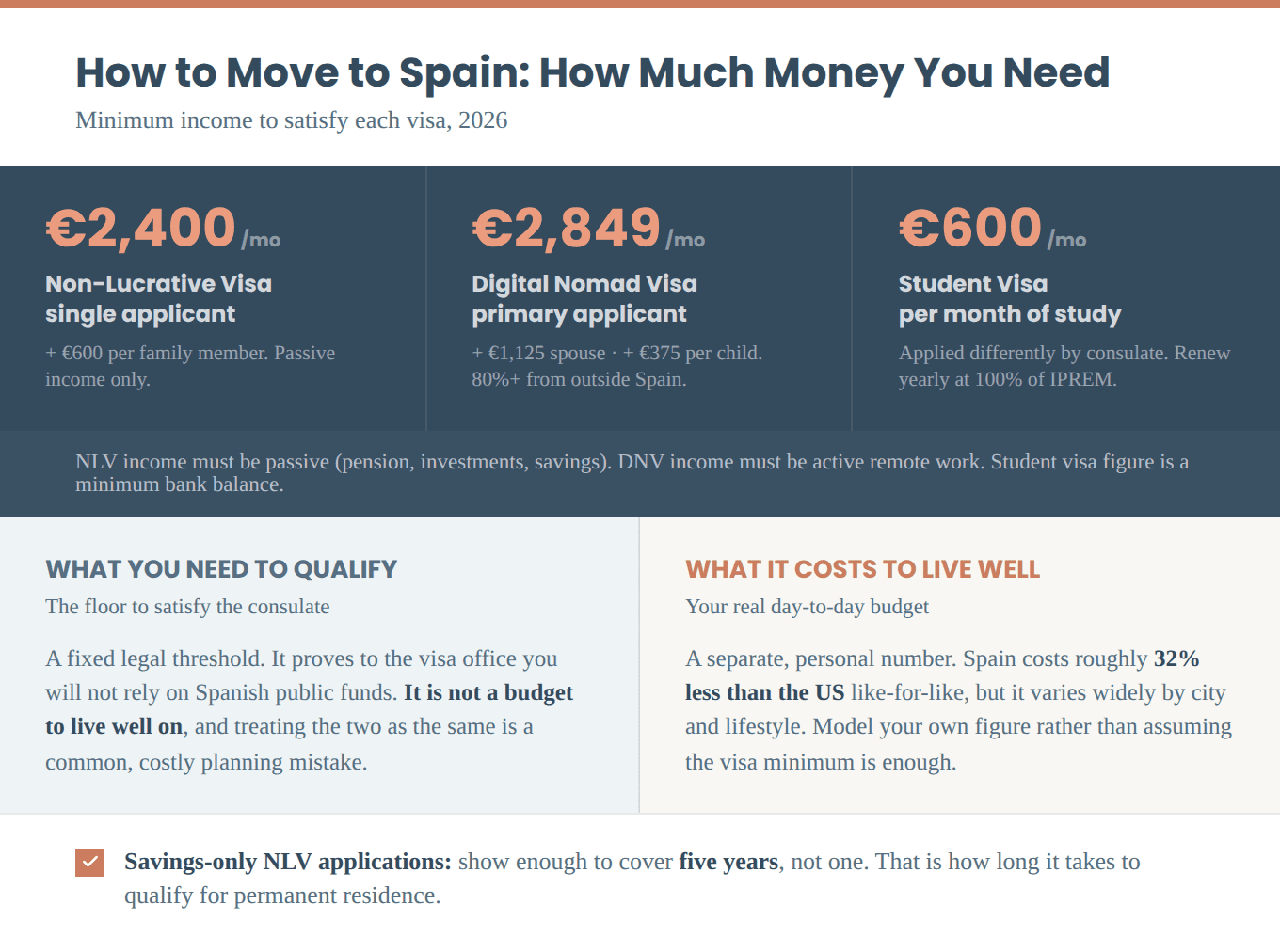
For the Non-Lucrative Visa, the minimum is €2,400 per month for a single applicant, plus €600 per month for each family member. This is 400% of IPREM (the Spanish government’s public income reference index, used to set minimum thresholds across a range of official requirements), and it has not changed for the past two years while Spain’s budget has remained stalled in parliament.
That income needs to come from passive sources: pension, investment income, rental income, or savings drawdown. If you are applying using just savings with no regular income, our expert immigration partner’s guidance is clear: you should be able to show enough to cover five years, not one. Five years is the minimum time required to qualify for permanent residence. An application showing one year of savings will be refused on the basis that you would not be able to renew.
For the NLV income and savings requirements in detail, including how to structure a savings-only application and what income types qualify, see our Non-Lucrative Visa guide.
For the Digital Nomad Visa, the income threshold is set at 200% of Spain’s minimum wage, currently €2,849 per month. At least 80% of that income must come from clients or an employer based outside Spain. See our Digital Nomad Visa guide for the full requirements. DNV holders may also be eligible for the Beckham Law, a special tax regime that taxes only Spanish-source income for the first six years. It is not available to NLV holders and is subject to specific conditions; our tax partner can confirm whether it applies to your situation.
What does it cost to live in Spain?
Our research puts Spain at around 32% less than the US on a like-for-like basis, across food, utilities, healthcare, transport, domestic help and dining. Useful as a direction of travel, but it hides significant variation within the country. Our cost of living in Spain guide has the detail behind that figure.
Rhys and Shannon, who moved from Atlanta to Valencia, describe it plainly. As business owners in the US they were paying outrageous healthcare costs. Here, the cost of living has let them take care of things they would not have managed at home, and travel within Spain in a way they could not have afforded before.
For modeling your own situation, the MTS Cost of Living Calculator covers 30 data points across nine Spanish cities. For one-off moving costs, the Moving Budget Planner gives you a structured estimate before you commit. If you are moving significant funds, our currency transfer service will save you considerably against a high street bank.
How long does it take to move to Spain?
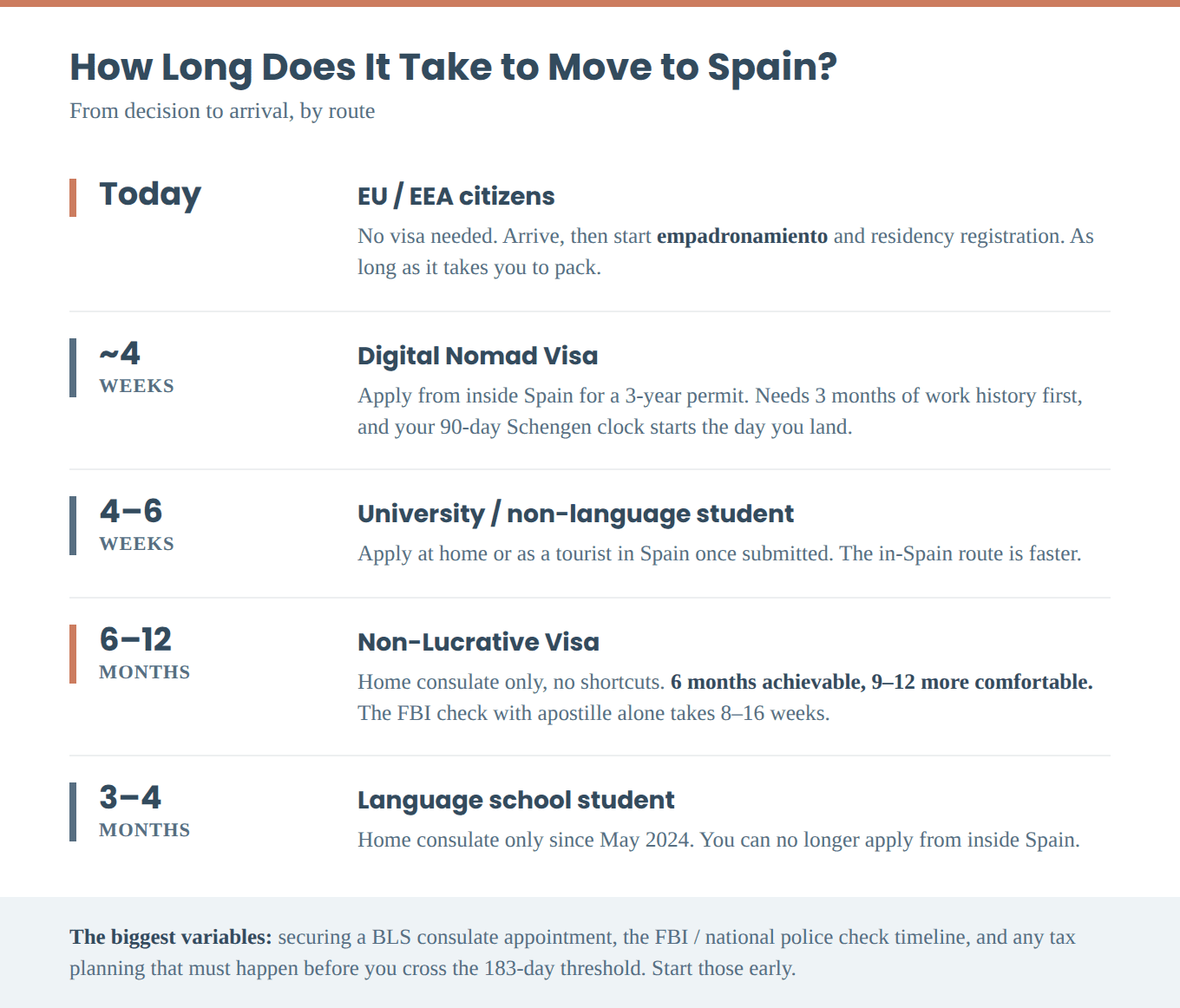
Six months is achievable for a straightforward Non-Lucrative Visa. Nine to twelve months is more comfortable. EU and EEA citizens can move as soon as they can pack, and a Digital Nomad Visa applied for from inside Spain typically takes around four weeks. The variable that decides it is your route
EU and EEA Citizens: You Can Move Tomorrow
As long as it takes you to pack. No visa application, no consulate appointment, no income threshold to clear in advance. Fly, arrive, find somewhere to live, then start the empadronamiento and registration process. The admin takes weeks, not months, and there is no waiting period before you begin.
Digital Nomad Visa: Fast, With Caveats
Around four weeks. The DNV can be applied for from inside Spain on a standard Schengen tourist entry, and the UGE typically processes in about four weeks, yielding a three-year permit. The caveats are real. Your 90-day Schengen allowance starts the moment you land. You need three months of employment or freelance history with your current employer or client before you can apply, so that window has to have passed before you arrive. And bank statements submitted to the UGE must be physically stamped by your bank, because digital downloads are regularly rejected.
University and Non-Language Student Visas: Apply in Spain or From Home
Four to six weeks. Either route is available, from your consulate or from inside Spain. The in-Spain route is faster.
Language School Student Visa: Consulate Only, No Exceptions
Three to four months. Consulate only since May 2024. Allow three to four months from starting the process to holding an approved visa.
Non-Lucrative Visa: Six to Twelve Months, No Shortcuts
Consulate only. You cannot apply from inside Spain. This is the route most retirees take and where the timeline gets serious.
Three steps set the floor and none of them can be meaningfully shortened.
The Criminal Record Check
US applicants need the federal FBI check, not a state-level one, apostilled by the Secretary of State. Processing plus apostille typically runs 8 to 16 weeks, and the document is only valid for six months from issue, so timing it is a real constraint in both directions. UK applicants need an ACRO certificate from the National Police Chiefs’ Council, also apostilled, at 4 to 6 weeks. See our guide to criminal record checks for Spain.
The BLS Appointment
For US and UK applicants, NLV and DNV applications are processed by BLS International, and appointment availability is the single biggest variable in the whole timeline. Nobody can get that appointment on your behalf. The system uses biometric verification through your own computer’s camera, so anyone offering to secure a BLS appointment for a fee is running a scam. Start checking from day one and treat it as a parallel task alongside document gathering.
Consulate Processing
Around eight weeks after your appointment. Once the visa is issued you have 365 days to enter Spain.
“The timing of everything was the hardest part. You are relying on other people to get things done within a certain amount of time, because once you are told to apply, you have to do it within a window.”
Teresa Mehl, MTS client, moved from Seattle to Alicante on the Non-Lucrative Visa in February 2025
Realistic NLV timeline in our experience
| Step | Realistic timeframe |
| Engage an immigration lawyer, confirm visa route | Week 1-2 |
| Open BLS account, start searching for appointments | Week 1 — do in parallel with everything |
| FBI / national police check (apply and apostille) | 8-16 weeks |
| Health insurance (no pre-existing conditions) | 1-2 weeks |
| Health insurance (pre-existing conditions) | 4-8 weeks or more |
| Tax planning (if financial events are planned) | Start 6-18 months before the move if possible |
| Visa application to decision after BLS appointment | Approximately 8 weeks |
| Total: decision to arrival (NLV) | 6 months is achievable. 9-12 months more comfortable |
| Time after the visa is issued to arrive in Spain | 365 Days |
Arriving on a tourist visa and applying here
For DNV applicants and university students this is both legal and recommended. For everyone else the picture is more complicated.
It is technically possible to enter as a tourist and remain while pursuing certain applications. People do it. The risk is real. If your application is refused while you are in Spain your position is difficult. If you overstay your 90-day allowance while waiting, the consequences follow you across the whole Schengen Area. And applying under time pressure with the clock running is a stressful way to handle an already complex process.
We are not in the business of telling people what they cannot do. We are in the business of telling them what the risks are. Engaging an experienced Spanish immigration lawyer early will give you a realistic timeline and stop surprises derailing your arrival.
What documents do you need to move to Spain?
Every non-EU visa application rests on the same core set: a valid passport, an apostilled criminal record check, a medical certificate, proof of income or funds, qualifying health insurance, and sworn translations of anything not already in Spanish. Individual consulates add their own requirements, so confirm your own list, but these are the documents with the longest lead times and the ones that derail the most applications.
| Document | What it is | Lead time |
|---|---|---|
| Valid passport | Must cover the full visa period | Renew first if it expires soon |
| Criminal record check | Federal FBI check for US applicants, ACRO certificate for UK. State-level checks are not accepted | 8 to 16 weeks US, 4 to 6 weeks UK |
| Apostille | Hague apostille on the record check and other official documents | Included in the above |
| Medical certificate | A doctor’s certificate confirming you carry no diseases with public health implications under the International Health Regulations | 1 to 2 weeks |
| Proof of income or funds | Bank and investment statements. The UGE requires physically stamped statements for the DNV | Gather early |
| Qualifying health insurance | Must meet all seven criteria above | 1 to 2 weeks, 4 to 8 with pre-existing conditions |
| Sworn translation | Most documents must be translated by a traductor jurado, a translator certified by the Spanish Ministry of Foreign Affairs | 1 to 2 weeks |
Two things catch people out. The criminal record check is only valid for six months from issue, so getting it too early is as much of a problem as getting it too late. And a sworn translation is not the same as any competent translation. It has to come from a traductor jurado, and consulates reject translations that do not.
Because these documents have different lead times, different validity windows, and dependencies on each other, the sequence matters as much as the list. Our free interactive Spain moving checklist tracks every document and step against your own timeline, so you can see what has to be started now and what can wait.
What do you need to do before you move to Spain?
You can work through this whole sequence, step by step and at your own pace, in our moving to Spain checklist.
Five things are significantly easier before you become a Spanish tax resident.
- Sell your primary residence before you cross the 183-day threshold if you are relying on a capital gains exemption at home. Spain will not recognize it once you are tax resident here.
- Deal with tax-advantaged accounts. Roth accounts, ISAs and anything else whose tax-free status Spain does not recognize. The window closes when you cross the threshold.
- Engage a cross-border tax advisor. Planning before you move is optimization. Planning afterward is damage limitation.
- Start health insurance early, especially with pre-existing conditions. The medical assessment takes time and its outcome affects whether the rest of the plan can proceed.
- Start school research in October of the year before you want to enroll. Private international schools begin community conversations in October and open applications in January. Public and concertado schools, meaning state-subsidized private schools following the Spanish curriculum, run main enrolment from March to May. You can apply to private international schools from abroad, but for public and concertado places you need to be on the ground with your padrón and NIE in place. Expect nothing from anyone in August. Our school search service covers international, public and concertado schools across our main regions.
How do you find a home in Spain?
Spain has no central property listings system like Rightmove or Zillow. Every agency manages its own inventory and rarely cross-lists, so the same property can sit with three agencies at three prices without any of them knowing. Portals like Idealista exist and are widely used, but a meaningful share of listings are outdated, already let, or posted to harvest contact details. What you see online is a starting point, not an inventory.
“Your real estate agent in the US can go online, click through listings, make appointments, and see four or five properties in a weekend. That is not how it works here. There are multiple messages and conversations, documents being shared between you, the agent, and the landlord.”
Amanda Chigbrow, MTS Client Care and Sales Lead, American Expat in Valencia since 2021
Landlords and agencies want to see your passport, visa documentation, proof of income or savings, and references before they will show you anything, let alone hold it. The good news is that by the time you are searching you have gathered most of it for the visa application. Having it organized and ready to send at short notice is a real advantage over applicants who are not prepared.
Rent before you buy. Amanda’s consistent recommendation. Your daily rhythms, your sense of neighborhood and your understanding of where your community forms all shift significantly in the first three to six months. Buying before you have lived somewhere locks in a decision before you have the information to make it well.
Pets narrow the pool. Carin Cowell, our Málaga rental search partner, puts it at 50% to 60% of properties accepting pets depending on type and number, and notes it is often negotiable with the right approach. Her ace in the hole is sending the landlord a good photo of the pet.
For lease types, tenant rights and what to expect in each major city, see renting property in Spain. MTS has vetted rental search partners in Valencia, Madrid, Málaga, Alicante, Barcelona and elsewhere, and they work for you rather than the agency or the landlord.
What do you need to do when you arrive in Spain?
Four things, in order: secure accommodation on a lease of at least six months, register your address at the town hall to get your padrón, attend a TIE appointment at your local police station within 30 days of entering Spain, and activate your health insurance. EU citizens do the padrón first, then apply for their green certificate of registration.
The visa gets you into the country. What follows is a sequence that has to happen in the right order and within specific windows to activate your residency properly.
“Be organized. Make lists. Have everything on a shared calendar. Make copies of everything, especially when you get here, because you are going to need those copies for rentals, your TIE appointment, for everything that follows.”
Teresa Mehl, Alicante, Non-Lucrative Visa holder since February 2025
Non-EU nationals, NLV and DNV holders
- Step 1. Secure long-term accommodation. An Airbnb is fine for the application stage, but to register your address you need a rental agreement of at least six months.
- Step 2. Empadronamiento. Register your address at your local ayuntamiento with your rental agreement and passport. You need the padrón certificate for almost everything that follows.
- Step 3. TIE appointment at your local national police station within 30 days of entering Spain. Book as early as you can, because availability varies significantly by city.
- Step 4. Make sure your insurance is active and you know how to use it. Find out how to book an appointment, what the out-of-hours number is, and whether there is an app. You do not want to be working that out at 11pm when someone is unwell.
One thing people miss. Your home country driving license does not transfer. US and other non-EU licenses are not directly exchangeable, and you will need to take the full Spanish test, theory and practical, with an English option available for the theory. Start early after arrival if you plan to drive regularly.
EU citizens
Simpler, but you still have to do it. Empadronamiento first, with your rental agreement and passport. Then a police station appointment for your EU green certificate of registration, which is your official proof that you live here.
In theory that happens within 90 days of arriving. In practice, appointment availability in some cities makes that impossible, and nobody comes knocking if it takes longer. Raquel Moreno LLB is clear that there is no problem doing it later. What matters is that it gets done, not that it gets done inside an arbitrary window.
For the full post-arrival sequence see how to get Spanish residency. Opening a Spanish bank account is one of the first practical steps once your empadronamiento is in place, and you will need your NIE, passport and proof of address: see banking in Spain. For EU citizens, see the EU residency guide. For the route to permanent residency after five years, see the dedicated article.
Run your own move, or hand it over?
By this stage the question is not whether you can move. It is how much of it you want to hold yourself.
Self-Led Relocation is for people who want to run their own move with expert input on the parts that matter. Five specialist consultations, a planning call with your relocation coach, a check-in once the move is underway, and every tool and guide we have. You drive. You are not on your own while you do it.
Guided Custom Relocation is for people who would rather focus on the life they are moving toward than hold all the moving parts. Your own relocation coach coordinates every service the move needs, stays contactable on WhatsApp, meets you one to one through the process, and stays accountable from decision to settled. If a partner falls short, we replace them.
The honest way to choose is to ask where your threshold is. Both work. They suit different people.
See the Self-Led Relocation or book your Relocate Planning Session
Stage 3: Thrive >> I am here. Now what?
The bureaucratic sequence has an end. The integration process does not. It gradually stops feeling like a process and starts feeling like a life.
What is life like in Spain as an Expat?
Three things come up in every conversation we have with clients a year in: language, pace, and how much faster community forms than they expected.
Language
Start before you arrive. Keep going after. This is the single most consistent piece of advice from every contributor, client and Expat we have spoken to in ten years.
Amanda Chigbrow puts it simply: poco a poco. You do not need a lot and you do not need it fast. Enough Spanish to follow what someone says at the grocery store, or to answer a neighbor who greets you in the street, changes how settled you feel almost immediately. Alastair has been here ten years and still uses iTalki most Tuesdays to video-call a Spanish guy in Extremadura for conversation practice. Rhys and Shannon arrived in Valencia in late 2024 and had a tutor within weeks, plus a weekly intercambio with Valencians who want to practice their English. Teresa Mehl has been in Spanish classes three times a week for six months and says the difference to her daily life is enormous.
Pace
Two-hour lunches are real. People do not work weekends. An email sent at 3pm on Friday may get a reply after 10am on Monday. Amanda describes the urgency Americans tend to carry as something that does not go far here. Rhys describes arriving at the realization that people are holding space for time with their families, and how that eventually starts to feel good rather than frustrating.
Community
Community forms faster than most people expect. Rhys did not plan to make friends, because they were only staying a year. That plan lasted about two months. Her description of what makes the Expat and immigrant community here different is one of the most honest things anyone has said to us about this move: everyone shares some version of the same gene that lets you accept a different culture and get on with life. Having made the leap creates a connection quickly.
Amanda’s advice for people who want to integrate into Spanish life rather than only Expat life is specific: step into uncomfortable situations. Walk up to the group of Spanish-speaking parents at the school gate and stand there, even if you understand nothing. It will be awkward the first time. Do it anyway. Each time it gets easier.
Amanda’s observation after four years in Valencia is worth ending on. She said it about Americans, but in ten years we have heard it from people of every nationality we have worked with.
So many people move here thinking they are going to change Spain. Once you are here, Spain changes you.
Staying supported once you are here
MtS Membership gives you the community, the full webinar library, live Q&As, weekly partner drop-ins and in-person events across Spain, at whatever stage you are at. It is built to stay relevant whether you are still deciding or already settled.
Three steps are how you move to Spain
It seems like a huge undertaking, but we help people manage it every day. And, like our family, a new life in Spain is an amazing opportunity.
Spain rewards some patience, some perseverce, and some insider knowedge. With those three things in your armoury, half the battle is won.