

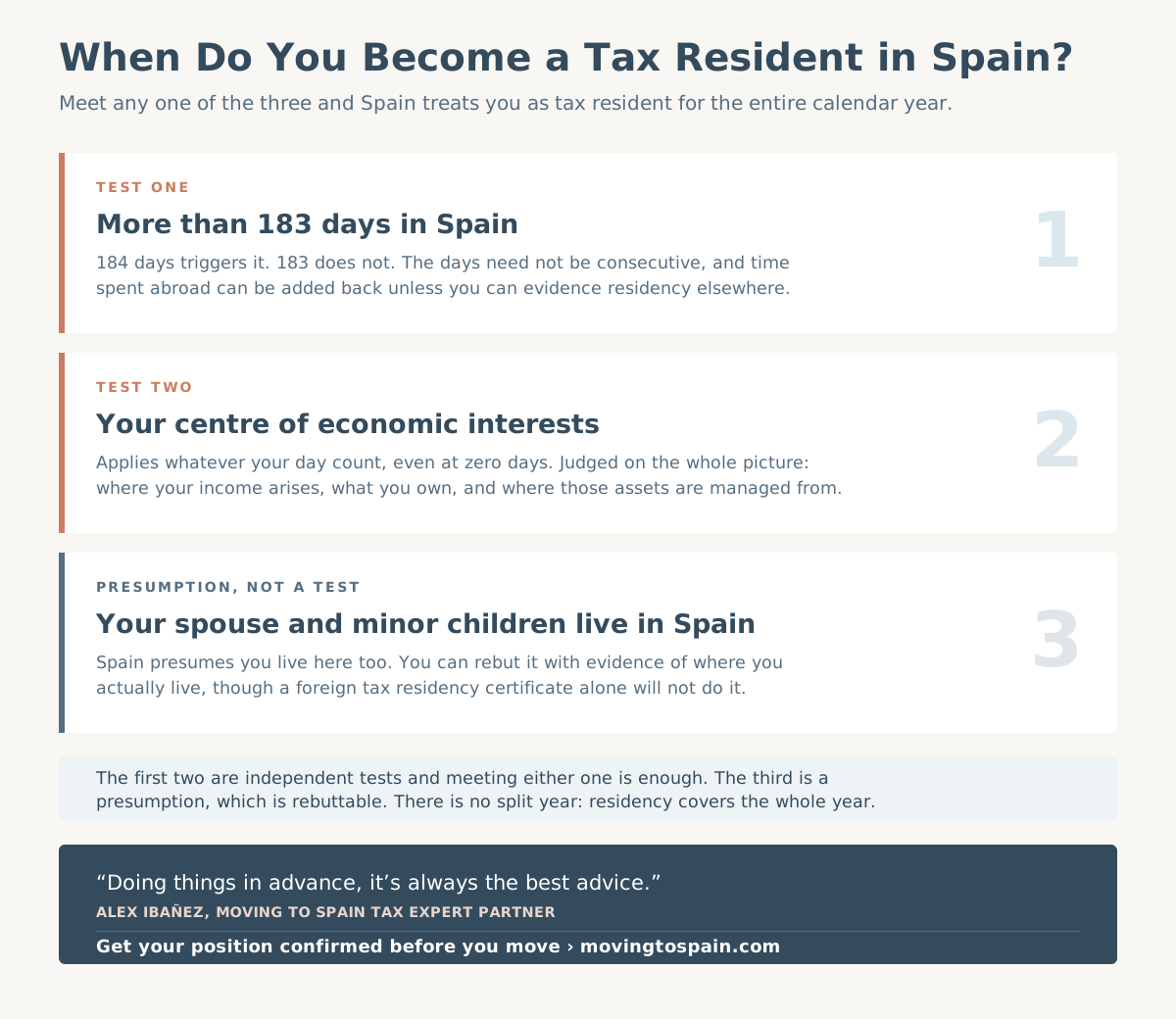
You become a tax resident in Spain the moment you meet either of two tests in a calendar year: you spend more than 183 days in Spanish territory, or the main base of your economic activities and interests is in Spain. Meeting one is enough. There is also a third route, a legal presumption rather than a test, which applies when your spouse and dependent minor children live in Spain. That one you can argue against, but only with evidence.
Tax residency decides whether Spain taxes your worldwide income or only what you earn here, and it is assessed fresh every calendar year, so you can be resident one year and not the next. This page covers how each test works, what it changes, and where people get caught out.
Is tax residency the same as legal residency?
No. They are separate systems that happen to use similar words, and confusing them is one of the most common errors we see. Legal residency is your immigration status, the visa or permit giving you the right to live here. Tax residency is a question of fact about where you are and where your economic life sits.
As MTS co-founder Alastair Johnson puts it,
“Your tax residency and your legal residency are two different things.”
Alastair Johnson, Co-founder Moving to Spain
You can hold a Spanish residence permit and not be a Spanish tax resident. You can hold no permit at all, arrive as a tourist, and become tax resident.
They do interact, and in one case the two are the same question. To renew a Non-Lucrative Visa you must have actually and effectively resided in Spain for more than 183 days during the calendar year. That is the same threshold, in the same words, over the same period as the tax test. So meeting the NLV renewal condition does not merely make Spanish tax residency likely. It means you have already met the day count.
This is a recent change and a lot of advice still in circulation is out of date. The old rule was a ground for cancelling a permit after six months of absence, and the Supreme Court struck that down in 2023. The current regulation, in force since May 2025, put the requirement back in a different place: not as a penalty for leaving, but as a condition you have to satisfy to renew.
The Digital Nomad Visa is structured differently and may open a different route, covered below.
If you are choosing a visa route, settle this before you apply rather than after.
What are the three ways Spain decides you are a tax resident?
Article 9 of Spain’s Personal Income Tax Law sets out the grounds.
Test One: More than 183 days in the calendar year
The threshold is more than 183 days of presence in Spain during a single calendar year. That means 184 days triggers it and 183 does not.
That sounds pedantic until you are choosing an arrival date. In a 365-day year, arriving on 2 July puts you in Spain for exactly 183 days, which does not meet the test. Arriving on 1 July gives you 184, which does. One day either side of that line changes whether Spain taxes your worldwide income for the entire year.
Important: The days do not have to be consecutive. Spain adds up every day of presence across the year.
Test Two: Your centre of economic interests
Even under 184 days, you are a Spanish tax resident if the main core or base of your activities or economic interests sits in Spain, directly or indirectly. This is an independent ground under Article 9.1.b, not a qualifier on the day count, and neither ground outranks the other.
It is not a question about where your employer is registered, and it is not only a question about from where your salary arrives. Spain’s Supreme Court settled the interpretation in two 2024 judgments: you weigh the whole picture. That means where your income arises, where your property and investments are, and where those assets are administered and managed from.
Alex Ibañez, tax partner at Vero Capital and reviewer of this article, describes the same shift from practice:
Historically that was the criteria Spanish courts and tax authorities were following. Now they are starting to consider as well, where do we have the majority of our assets.
Alex Ibañez, Moving to Spain Tax Expert Partner
Ibañez gives the example of someone hired to work remotely from Spain in the second half of the year who receives a large signing bonus.
Because the payment relates to employment carried out in Spain, it can count as Spanish-source income, and it can be large enough that most of that year’s income is Spanish. The day count never comes into it.
How much tax will you actually pay in Spain?
The answer is very specific to your situation – your income mix, investments, which Spanish region you choose, and the structures available to you. Get clarity from our vetted tax specialists who work with expats like you every day.
The presumption: Your spouse and dependent minor children live in Spain
If your legally non-separated spouse and dependent minor children habitually live in Spain, Spain presumes you live there too. This sits in the closing paragraph of Article 9.1 as a presumption, not as a third test.
Being a presumption, it can be rebutted, but not by explaining that your life is centered somewhere else. You rebut it with evidence about where you actually live: a foreign employment contract, a foreign lease or utility bills in your name, foreign tax filings, children enrolled in schools outside Spain. Argument alone does not shift it, evidence does.
A tax residency certificate doesn’t cut it
One thing will not rebut it, and this is the trap. A tax residency certificate from another country does not affect this presumption. Spain’s tax authority treats a foreign certificate as a bearing on the day count and nothing else, so it cannot displace the family presumption, and it cannot displace the economic interests ground either. People produce a certificate, assume the question is closed, and find it was never the right document for the problem.
Spain Tax Residency Check Tool
Are you likely to be a Spanish tax resident?
Spanish law sets out three separate grounds. Meeting any one of them is enough. This check shows which of the three appear to apply to your situation, and what each one turns on.
What this does not do. It does not decide your tax status and it produces no tax figures.
It is built for people arriving in Spain or spending time there. If you are leaving Spain, if you already hold the Beckham regime, or if you are resident in a jurisdiction Spain treats as a tax haven, the rules work differently and you should speak to an adviser instead.
Spanish tax residency is decided year by year, over the calendar year. There is no split year.
Count every day you were in Spain at any point, including the day you arrived and the day you left. There is no minimum number of hours, so a few hours counts as a full day. Short trips add up across the year, so count all of them.
This is the part of the day count people most often get wrong. Time away from a Spanish base is treated differently from living somewhere else.
For example, a month back home over the summer, or a long work trip, while the home you live in stays in Spain.
An official certificate from that country’s tax authority. Not a visa, a lease, or a utility bill.
This is not about where you were physically living. Being in Spain does not by itself put your economic base here.
Think about your finances as a whole, not only your salary. Consider where your income arose, where your property and investments are, and where they are managed from. If you moved partway through the year, income from before the move counts too.
Data verified 25 August 2026. Based on article 9.1 of Ley 35/2006 (LIRPF), Tribunal Supremo judgments 1214/2024 and 1393/2024, and TEAC resolutions RG 4045/2020 and RG 4812/2020. Read the full methodology.
What is a Spanish tax residency certificate, and why does it matter here?
A tax residency certificate is an official document from a tax authority confirming you are tax resident in that country. Spain's is issued by the Agencia Tributaria on request, using Modelo 01, and is normally valid for one year from issue.
It does one job only. If you are arguing that time spent outside Spain should not count toward your Spanish day total, a certificate from the country where you were actually resident is what the tax authority will ask for. Without one, those days tend to be added back.
What it does not do is settle your residency generally. It bears on the day count alone, not on the economic interests ground, and not on the family presumption. Certificates also cover a specific year, so you need the right year, and you need to request it in time.
One thing worth knowing before you rely on it: a foreign certificate is necessary but not always sufficient. Spain's tax authority can accept the certificate and still ask you to evidence where you physically were, day by day. That is a record you cannot construct after the fact, which is the argument for keeping travel documentation as you go rather than when someone asks.
How does the 183 day rule in Spain actually work?
The day count is not a simple tally of nights spent in the country, which is where confident assumptions fall apart.
- Any part of a day counts as a day. Land at 11pm and that is a day in Spain. Leave at 6am and that is a day too. Both your arrival day and your departure day count.
- Transit does not count. Changing planes in a Spanish airport without entering the country is not presence.
- If you claim residency in a jurisdiction Spain treats as a tax haven, the burden flips. Article 9.1.a lets the tax authority require you to prove you were actually present in that jurisdiction for 183 days, rather than requiring Spain to prove you were here.
- Time outside Spain can still count as time in Spain. Under the sporadic absences rule, days abroad are added to your Spanish total unless you can prove you were tax resident in another country during that period. A two-month trip does not automatically reduce your count. Without proof of residency elsewhere, it can be treated as if you never left.
Ibañez points to the Shakira case. She had not reached the threshold on physical presence alone, but the tax authority argued her time abroad was time she could not be in Spain rather than time genuinely resident elsewhere, and counted it against her.
Is the Spanish tax year the same as the calendar year?
Yes. Spain's tax year runs 1 January to 31 December, and there is no split-year treatment. You are either resident for the entire year or not resident for the entire year. There is no partial-year status.
So if you cross the 183-day threshold in November, you were a Spanish tax resident from 1 January of that year. Income earned abroad in February, before you had any connection to Spain, falls inside your Spanish return.
Ricardo Jesus, financial advisor at Liberty Atlantic Advisors, made the comparison directly in an MTS webinar:
Even if you reach the 183 days by December of a specific year, you become a tax resident for the whole year. This doesn't happen, for example, in Portugal. If you become a tax resident in December, you start paying taxes from December forwards.
Ricardo Jesus, Liberty Atlantic Advisors
That makes the timing of a move a decision, not a detail. Any capital event you are planning, selling a property, taking a large distribution, realizing a gain, lands inside whichever tax year you are resident for.
One family who joined an MTS webinar described working this out for themselves. They were moving to Asturias and selling their US home, and the sale qualified for the US primary residence exclusion. What they realized later was that if they became Spanish tax resident in the same calendar year as the sale, Spain would be looking at a gain the US had already exempted. They moved their arrival date back past 1 July so the sale fell in a year they were not Spanish tax resident. Nobody had told them to check. They found it by asking the question. - Moving to Spain Webinar, Mistakes Americans Make Moving to Spain May 14 2026
The point is not the date. It is that the question is worth asking before the move rather than after, because the answer stops being available once the year has started.
How is the 90/180 Schengen rule different from the 183 day rule?
These two rules get conflated constantly, and it has become easier to get confused rather than harder.
The Schengen rule is an immigration rule limiting non-EU visitors to 90 days in the Schengen Area in any rolling 180-day period. The 183-day rule is a tax rule asking how many days you spent in Spain in a fixed calendar year. Different purpose, period, threshold, and authority.
Since the EU's Entry/Exit System (EES) became fully operational at all external Schengen borders on 10 April 2026, entries and exits are recorded biometrically rather than stamped. That gives you an official, automated count of your Schengen days, and it is easy to assume it answers the tax question too. It does not. It runs on a rolling window rather than the calendar year, covers the whole Schengen Area rather than Spain, and treats days outside Spain as days outside, where Spanish tax law may add them back.
You can stay comfortably inside the Schengen limit and still become a Spanish tax resident, and the reverse is possible too. For the immigration side, see our guide to the Schengen 90/180 day rule in Spain.
Not sure which side of the line you fall on?
The arrival year is the one that usually costs money, and it is the one that responds best to planning. A short conversation with a Spanish tax adviser will tell you where you stand before you commit to a date.
How much tax will you actually pay in Spain?
The answer is very specific to your situation - your income mix, investments, which Spanish region you choose, and the structures available to you. Get clarity from our vetted tax specialists who work with expats like you every day.
What changes once you become a Spanish tax resident?
Three things, and they are why the threshold matters.
Your worldwide income becomes taxable in Spain. Salary, pensions, rental income, investment income and capital gains from anywhere enter your Spanish return. See our guide to personal income tax in Spain and how La Renta works.
You may have to report your foreign assets. Spanish tax residents file Modelo 720 where holdings in any of three categories, foreign bank accounts, foreign investments and pensions, or foreign real estate, exceed €50,000. The threshold applies per category, so you can trigger one without the others. Crypto on foreign platforms goes on Modelo 721 at the same threshold. Both are due by 31 March for the position held on 31 December. Neither creates a tax bill. They are information returns, and the penalties are for not filing.
You may come into wealth tax. Residents are assessed on worldwide assets, with a general allowance of around €700,000 per person plus up to €300,000 on a main residence, though the rules vary substantially by autonomous community. Above €3 million of net wealth, the national Solidarity Tax on Large Fortunes also applies. See our guide to wealth tax in Spain.
If you are also tax resident in another country, a double taxation treaty may resolve your position differently from what the Spanish rules alone suggest, so the Spanish tests are the start of the analysis rather than the end of it.
If pensions or Social Security are part of your income, Spanish treatment depends on the type of payment. See our guide to how Spain taxes Social Security and pensions.
What if you are not a Spanish tax resident?
You are taxed only on your Spanish-source income and Spanish assets, under a separate regime for non-residents rather than the resident income tax system.
That usually means a flat rate on Spanish rental income or capital gains rather than the progressive resident bands, no obligation to report foreign assets on Modelo 720 or 721, and wealth tax on Spanish assets only. Non-residents from outside the EU and EEA, which since Brexit includes Britons as well as Americans, pay the higher of the two non-resident rates.
If you own a Spanish property you do not rent out, you still owe an annual charge on it. Spain imputes a notional rental income based on a small percentage of the property's cadastral value and taxes that, whether or not a tenant ever sets foot in it. This surprises a lot of second-home owners.
What non-residency does not do is make you invisible. Owning property, earning rent or selling a Spanish asset all create obligations regardless of where you live. For Digital Nomad Visa holders, non-resident years still count at renewal, given what the UGE checks on your tax returns.
Five mistakes we see people make
Counting Schengen days as tax days. An official EES record of your Schengen days tells you nothing definitive about your Spanish tax position.
Assuming a foreign employment contract keeps you out. Where your employer is registered is not the test. Where you are, and where your economic interests sit, is.
Forgetting the family presumption. People plan their own day count carefully and overlook that a spouse and children living in Spain creates a presumption against them anyway.
Planning around 183 when the test is more than 183. An arrival date out by one day is an expensive error, and the most common we see.
Treating trips abroad as reducing the count. Without a certificate from the country you were actually resident in, those days can be added straight back.
Can the Beckham Law reduce the tax hit?
For some people, yes. Spain's regime for inbound workers, set out in Article 93 of the income tax law and known as the Beckham Law, taxes qualifying new arrivals at a flat 24% on Spanish-source employment income up to €600,000, and 47% above. Foreign-source investment income is generally outside the Spanish net, and it runs for the year you arrive plus five.
It is not a general exemption and not automatic. You must not have been a Spanish tax resident in the previous five years, you must be moving for a qualifying reason, and you must elect into it on Modelo 149 within six months of registering with Spanish Social Security. Miss that window and it closes permanently, so treat this as a signpost rather than a plan.
What US citizens need to know
The United States taxes its citizens on worldwide income wherever they live. Becoming a Spanish tax resident does not change that, so two systems reach the same income at once.
The double taxation treaty decides which country gives relief, and it does this income stream by income stream rather than in one sweep. Broadly, where income is US-sourced the US side relieves the double taxation, and where it is Spanish-sourced employment income, Spain does. Working out which is which is the trick.
How Spain characterizes each type of US retirement income decides what you pay, and the answers are not intuitive. Whether a traditional IRA or workplace pension is taxable in Spain at all turns on whether the underlying service was public or private employment. A Roth is treated as an investment rather than a pension, so its US tax-free status does not carry across, and that particular point is genuinely contested among Spanish advisers.
Two accounts of similar size can produce quite different Spanish outcomes. Our guide to how Spain taxes Social Security and pensions works through each account type.
On the US side, the Foreign Earned Income Exclusion and the Foreign Tax Credit are the two main mechanisms, and the choice between them can change your position once you are Spanish resident. Which applies is a question for your US preparer.
The arrival year is where the damage happens. Ibañez is direct about it: if your preparer does not know you are becoming Spanish resident, returns get filed on the wrong assumptions, and the double taxation then has to be unwound rather than avoided. Coordinating both sides before you move is the most useful thing you can do.
For more on the US side of a move, see our guide to moving to Spain from the USA.
Need Help with Your US Expat Taxes?
We recommend MyExpatTaxes, designed for Americans living overseas. You can choose the approach that suits you best, whether you want to file on your own or work with a tax professional. They also supports past-year filings if you're behind.
What UK citizens need to know
The UK uses the Statutory Residence Test, a structured set of automatic and sufficient-ties tests, and it allows split-year treatment, so a UK tax year can be divided into resident and non-resident parts. Spain has neither. You are Spanish resident for the whole calendar year or not at all.
The tax years do not line up either. The UK year runs to early April, Spain's to 31 December, so income can fall into different reporting periods and relief for tax paid abroad does not always land in the year you expect.
Leaving the UK does not automatically end your UK exposure. The Statutory Residence Test can keep you UK resident on ties alone after you have moved, UK rental income stays in the UK net at source, and pension income is generally taxable in Spain once you are resident here, with government service pensions the significant exception. Our guide to how Spain taxes Social Security and pensions covers which pensions fall where.
The item that catches British movers hardest is the ISA. Spain does not recognize the UK's tax-free wrapper, so income and gains inside an ISA are generally taxable here once you are resident, even though nothing changed on the UK side. Premium Bonds and similar UK wrappers are treated the same way. A portfolio that was tax-free the year before becomes a reportable, taxable holding.
Where both countries would treat you as resident, the UK-Spain double taxation agreement contains a tie-breaker. It looks at where you have a permanent home, then your center of vital interests, then habitual abode, then nationality, in that order.
Get advice from a Spanish cross-border tax specialist
Three grounds, any one of which is enough. A calendar year that cannot be split. A day count that can include days you spent somewhere else. Those are the rules, and they are knowable. What is not knowable from a page like this one is how they land on your particular set of facts, because the tests interact, and the answer changes depending on where your income arises, what you own, where you own it, and who is living with you.
The arrival year is the one that usually costs money, and it is also the one that responds best to being thought about early. Almost every expensive mistake we see in this area was avoidable twelve months earlier and unfixable by the time anyone noticed.
Alex Ibañez put it plainly when he summed up his session on Spanish tax for Expats:
Doing things in advance is always the best advice. - Alex Ibañez, Moving to Spain Tax Expert Partner
Nothing on this page is tax advice, and none of it is a substitute for someone looking at your situation. If you are working out when to move, when to sell, or whether you are already tax resident without realizing it, get your position confirmed by a specialist who works across both systems before you act on it.
How much tax will you actually pay in Spain?
The answer is very specific to your situation - your income mix, investments, which Spanish region you choose, and the structures available to you. Get clarity from our vetted tax specialists who work with expats like you every day.