
Is the cost of living in Spain cheaper than in the US or the UK? We’ve lived in Spain since 2015 and travel regularly to the US and UK. So, for us, this is a simple question to answer, but we wanted to get some verified data to make sure our feelings were correct. Spain is cheaper, but by how much depends on how and where you currently live. This guide explains how everyday living costs in Spain compare to those in the US and the UK, using verified, up-to-date data for 2026, combined with firsthand relocation experience from working directly with people planning real moves, not hypothetical budgets. This direct contrast is a central focus of our comprehensive American relocation guide.
How Does Spain’s Cost of Living Compare to the US and the UK Overall?
This is a country-level cost-of-living guide, not a city budget calculator. It explains how Spain compares to the US and the UK on average, using nationally comparable data. National averages are useful for setting expectations, but they do not reflect what any individual household will spend. That is why this guide is designed as a companion to a Spain cost-of-living calculator, which allows you to compare specific Spanish cities, housing options, and lifestyles once you understand the broader picture.
Overall Cost of Living Comparison (National Averages)
| Metric | Spain | United States | United Kingdom |
|---|---|---|---|
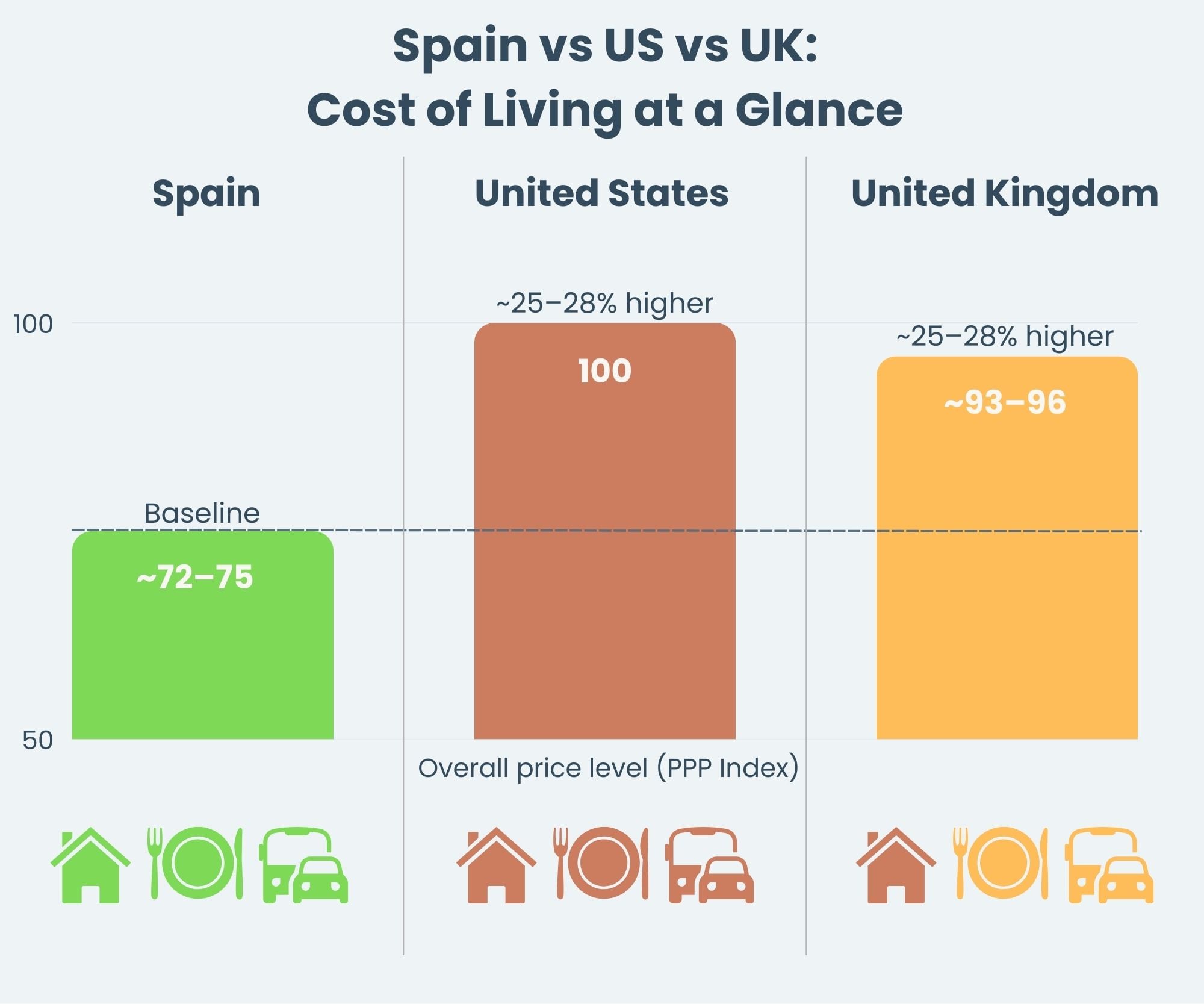
| Overall price level (PPP) | ~72–75 | 100 | ~93–96 |
| Relative cost vs Spain | Baseline | ~25–28% higher | ~12–15% higher |
| Housing costs (national) | Lower | Higher | Higher |
| Food & eating out | Lower | Higher | Medium |
| Transport costs | Lower | Higher | Medium |
| Cost-of-living trend (last 10 yrs) | ↑ (slower) | ↑ (faster) | ↑ (moderate) |
Is Spain Cheaper Than the United States Overall?
Yes. At a national level, Spain is materially cheaper than the United States for everyday living costs.
Using Purchasing Power Parity (PPP)–adjusted price levels from the OECD, the United States is set as the baseline at 100:
- United States: ~100
- Spain: ~72–75
This means that, on average, a basket of everyday goods and services that costs $100 in the US costs roughly $72–$75 in Spain, excluding tax and healthcare.
Put differently:
- Spain’s overall price level is approximately 25–28% lower than the US
- The gap is driven primarily by housing, local services, food, and transport
However, this gap is not uniform:
- Compared to New York, San Francisco, or Boston, Spain is dramatically cheaper
- Compared to lower-cost US regions, the difference shrinks but does not disappear
For a first-person perspective on what these numbers mean in practice, our guide to Americans living in Spain covers how US Expats experience the cost difference day-to-day, from groceries and healthcare to social life and work-life balance.
Is Spain Cheaper Than the United Kingdom Overall?
Yes, Spain is cheaper than the UK, but by a smaller margin.
Using the same OECD price level framework (UK ≈ 100):
- United Kingdom: ~100
- Spain: ~85–88
This means that Spain is around 12–15% cheaper than the UK overall for core living costs.
Category-level patterns matter:
- Housing: Spain remains significantly cheaper than London and the South East
- Food & eating out: Spain is typically 10–20% cheaper
- Utilities: The gap has narrowed and can be inconsistent year to year
“Electricity, water, and gas if there is gas, are paid by the tenant. Wi-Fi is something you sign up for yourself, you can generally get a package for around €40 a month. For electricity, I tend to say a couple should budget under €100 a month, but averaging around €100 is a safe assumption.” Carin Cowell, Málaga Rental & Property Expert, Moving to Spain Webinar, April 2026
Spain is cheaper than the UK on average, but the advantage is narrower and more category-dependent than with the US.
How Do Housing Costs Compare at a National Level: Spain vs. the US vs. the UK?
Housing is the single biggest driver of cost-of-living differences.
Using national rent indices (OECD + Eurostat aligned):
- Average market rents in Spain are ~40–60% lower than in the US
- Average market rents in Spain are ~30–40% lower than in the UK
However:
- Spain has far wider internal rent dispersion
- A central Barcelona apartment can rival mid-tier UK cities
- Smaller Spanish cities remain dramatically cheaper
This is why rent must be selected explicitly in any serious calculator. Check out our cost-of-living calculator to compare living costs across 9 Spanish cities.
“I regularly work with clients whose budget is half of €3,000. €1,500 a month can get you a decent property, it will just be on a smaller scale. If you are looking for something more premium and you have a salary from abroad or you are living off savings, that is when the higher budget comes into play.” Carin Cowell, Málaga Rental & Property Expert, Moving to Spain Webinar, April 2026
Read More >> Spanish Property Rental Values
Spain vs US vs UK: Cost of Living Snapshot
| Metric | Spain | United States | United Kingdom |
|---|---|---|---|
| Overall price level (PPP) | ~72–75 | 100 | ~93–96 |
| Housing cost pressure | Low–Medium | High | Medium–High |
| Food prices | Lower | Higher | Medium |
| Transport dependency | Low–Medium | High | Medium |
| Lifestyle cost variability | High | Medium | Medium |
Has the Cost of Living in Spain Gone Up Compared to the US and the UK?
Has Spain Become More Expensive Over the Last 20 Years?
We hear repeatedly from long-term residents and repeat visitors: Spain no longer feels as cheap as it once did. And yes, prices in Spain are higher today than they were 20 years ago, but this is not unique to Spain.
Using long-run consumer price data from Eurostat, OECD, and national statistical offices:
- Spain: consumer prices are roughly +45–50% higher than in the mid-2000s
- United Kingdom: consumer prices are roughly +60–65% higher
- United States: consumer prices are roughly +65–70% higher
And, prices in the US and UK have risen faster and from a higher base, meaning Spain has maintained its relative cost advantage, even as local prices increased.
How Does Inflation in Spain Compare to the US and UK Over the Last 10 Years?
Looking at the last decade, a more relevant timeframe for most people planning a move today, the pattern is similar.
Approximate cumulative inflation (2014–2024):
- Spain: ~+25–30%
- United Kingdom: ~+30–35%
- United States: ~+35–40%
Spain experienced lower inflation than both the US and the UK over this period, particularly before 2021. The gap narrowed during the post-pandemic inflation surge, but Spain did not overtake either country in cumulative price growth.
In other words, Spain is more expensive than it was, but it did not get more expensive faster than the US or the UK.
Important: Inflation has not been uniform in Spain. Housing prices have increased much more in popular tourist areas like Barcelona and Valencia than in less popular and regional areas.
Cumulative Inflation Spain vs the US vs the UK Comparison
| Period | Spain | United States | United Kingdom |
|---|---|---|---|
| Last 20 years | +45–50% | +65–70% | +60–65% |
| Last 10 years | +25–30% | +35–40% | +30–35% |
| Last 5 years | +15–20% | +20–25% | +20–25% |
Why People Say “Spain Isn’t as Cheap as It Used to Be”
This perception is understandable, but it is often misinterpreted. In our experience, there are three main factors that drive it:
1) Absolute prices have risen
€1 coffees and €6 menus del día are less common than they were 15 years ago. People are correct that inflation has shifted prices, especially in popular areas.
2) People anchor to memory, not comparison
Many comparisons are drawn with Spain in the past, not with the US or the UK today. For Expats who moved to Spain a long time ago, this change is felt relative to what they remember in Spain, not what they left behind.
3) Tourism pricing is more visible
Visitors and new arrivals often encounter higher prices in tourist-heavy areas, which do not reflect everyday resident spending.
The key point: Spain is not as cheap as it once was, but neither is anywhere else.
Why National Cost of Living Averages Only Tell Part of the Story
Why National Averages Are Misleading for People Moving to Spain
Within a 90-minute drive of our house, we can reach Barcelona, Tarragona, and rural Aragon. The price ranges we encounter for items, from hotel rooms to lunch, are extraordinary. A men’s haircut in central Barcelona may be €30, in Tarragona €12, and in a small Aragon town maybe €8 with a wet shave throw in! The rent you pay for a one-bedroom apartment in a fancy Barcelona suburb like Gracia will get you a 6-bedroom mansion with a swimming pool and an orchard in the countryside.
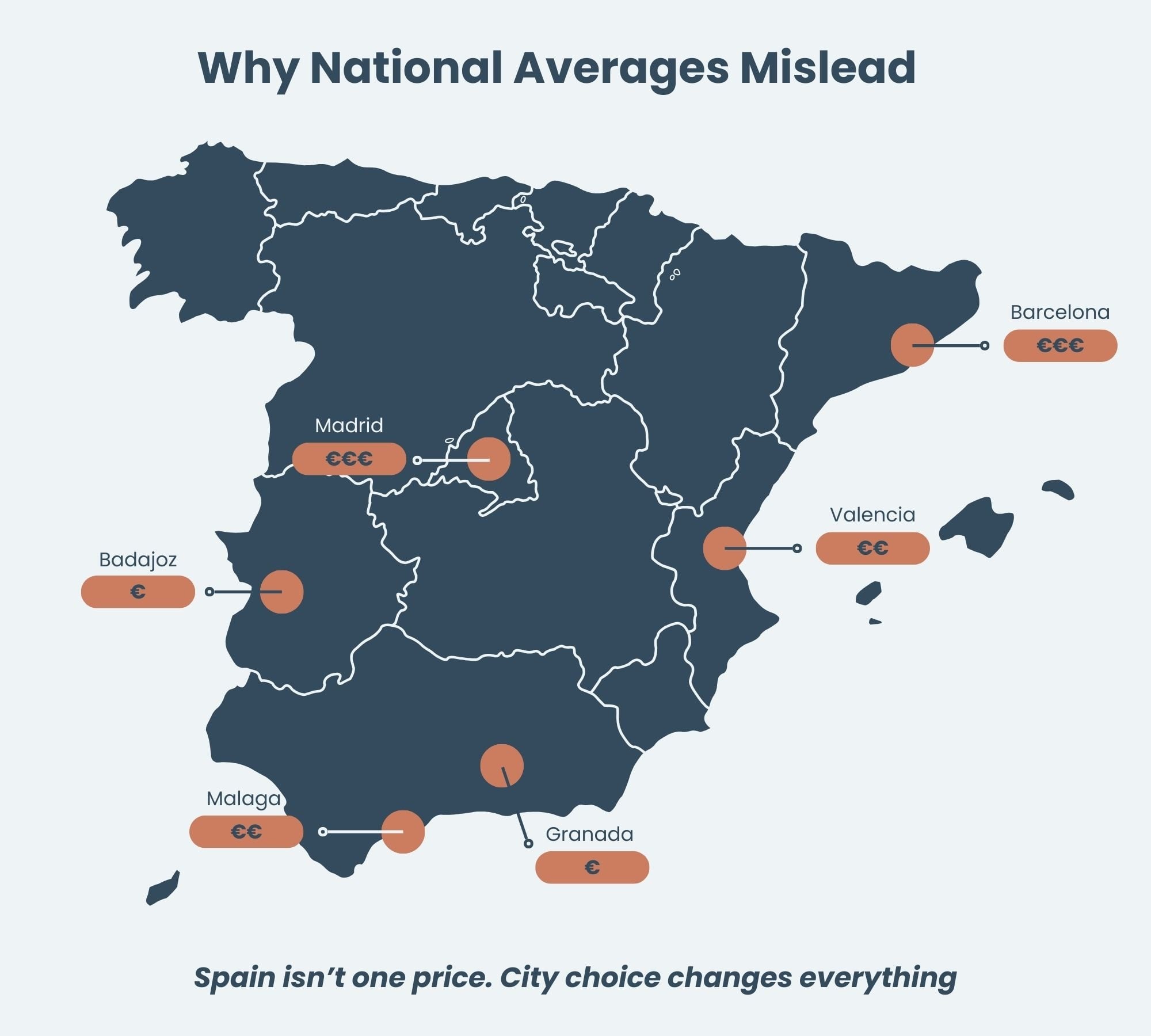
National cost-of-living figures reflect what the average household pays across an entire country, not what a new arrival will experience in a specific location. Spain has significant internal variations in housing costs, transportation needs, and everyday services, which means national averages smooth out extremes that matter in real life.
How Much Does the Cost of Living Vary Within Spain?
The variation in living costs within Spain is substantial.
Using housing as the clearest example:
- Average long-term rents in prime areas of Madrid or Barcelona can be 50–150% higher than rents in smaller cities or inland regions.
- Secondary cities and provincial capitals often have significantly lower housing costs while offering similar access to healthcare, transport, and services.
- Utility costs, transport spending, and lifestyle expenses also vary depending on climate, density, and infrastructure.
This level of internal variation means that where you live in Spain matters more than Spain’s national average price level.
Read More >> Spanish Property Rental Values
Why City Choice Matters As Much as Country Choice in Spain
For many movers, the biggest cost-of-living decision is not Spain versus the US or UK, but Madrid versus Valencia, Barcelona versus Málaga, or coastal versus inland Spain.
Two households with identical lifestyles can face very different monthly costs simply by choosing different Spanish cities. Housing alone can account for the majority of this difference, but transport, eating out, and leisure costs also respond strongly to local conditions.
Car ownership is a significant part of the transport picture for many Expats, particularly outside major cities. See our full guide to buying a car in Spain for a breakdown of purchase costs, registration, and what to expect.
This is why national cost-of-living comparisons should be treated as context, not conclusions. They explain why Spain can be cheaper, but they do not explain where in Spain it will be cheaper for you.
How to Use National Averages Correctly
National cost-of-living data works best when used to:
- Set realistic expectations
- Understand broad structural differences between countries
- Avoid misleading comparisons based on outliers
Once that context is clear, meaningful planning requires city-level comparisons with explicit assumptions about rent, household size, and lifestyle.
“Where you live and your lifestyle makes a much bigger difference to your budget than which country you’re in.” Alastair Johnson, Co-founder, Moving to Spain, Cost of Living Across Spain Webinar, April 2026
That is precisely the gap our updated Spain cost-of-living calculator fills, translating national context into place-specific reality.
Are “Fun” Cost of Living Indexes Like the Big Mac Index Actually Useful?
My Dad was a travel agent, and he swore that after one dinner and a couple of beers, he could pretty accurately guess the cost of living in the city or town he was in. His point is supported by indices such as the Big Mac and Beer indices.
What Is the Big Mac Index and What Does It Say About Spain?
The Big Mac Index compares the price of the same burger in different countries to illustrate purchasing power. I like it because it removes branding, quality debates, and lifestyle differences, a Big Mac is a Big Mac.
However, where Spain genuinely diverges from the US and the UK is in locally produced goods and services: a coffee made by a person in a neighborhood bar, a three-course lunch cooked fresh in a local restaurant, apartment rent, a haircut, a taxi. These are the categories that drive the real cost-of-living difference, and none of them come with sesame buns.
And there is a catch that most Big Mac comparisons get wrong, including our original version of this section: the US displays all menu prices before sales tax, while Spain and the UK are legally required to include VAT in every displayed price. That means a straight menu-price comparison overstates how expensive Spain and the UK are relative to the US.
To make a proper like-for-like comparison, the prices below are after-tax and in-restaurant for all three cities.
| Location | After-tax in-restaurant price | Local currency |
|---|---|---|
| Madrid | €5.50 | (€5.50) |
| London | €5.15 | (£4.50) |
| New York City | €6.65 | ($7.30 inc. tax) |
Is Beer Cheaper in Spain Than in the US and UK?
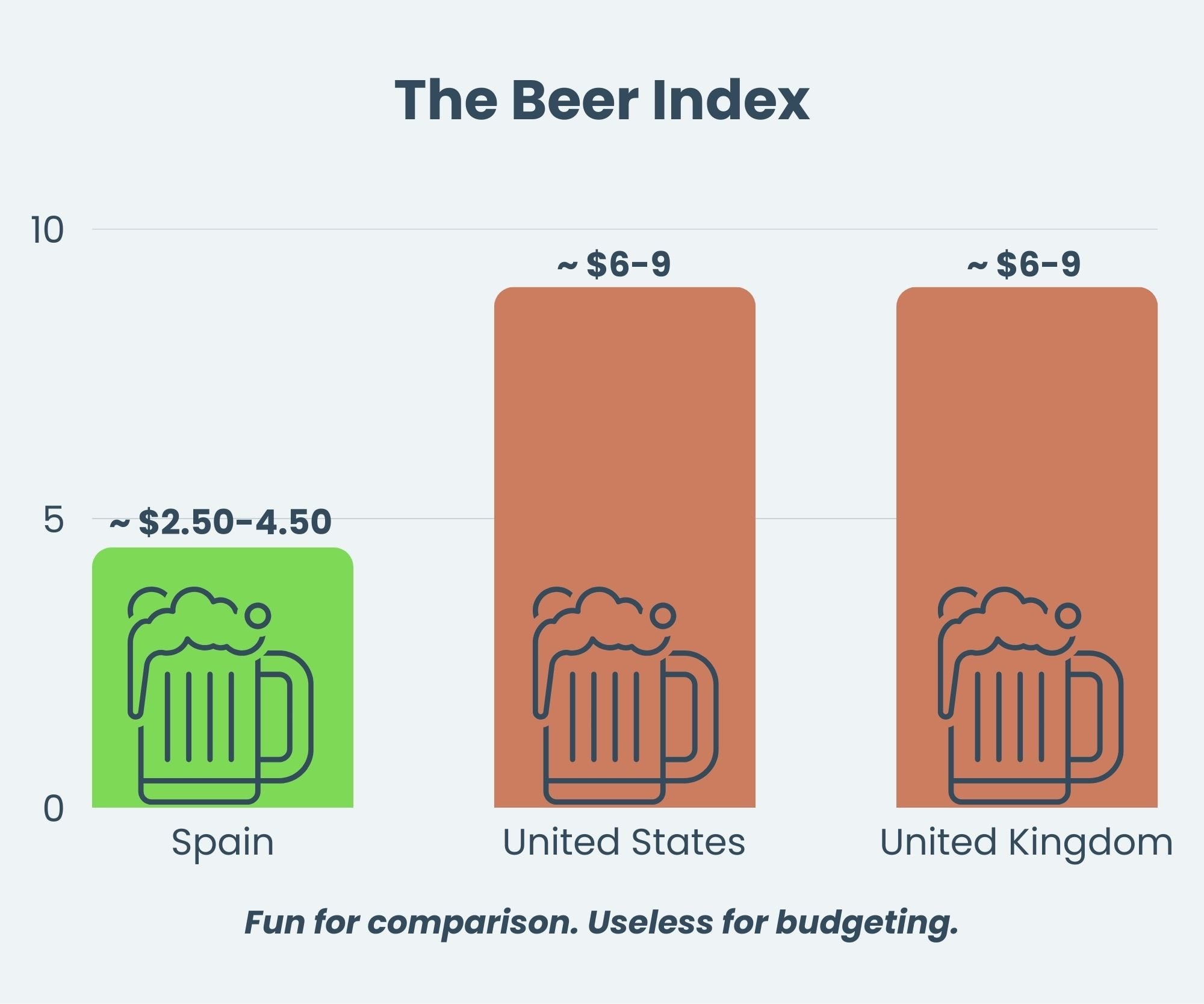
Yes, and this one does affect day-to-day life (well, mine…). From first-hand experience, beer in Spain is noticeably cheaper than in the US and UK in almost every context.
| City | Typical Beer Price (USD) | Context |
|---|---|---|
| Madrid | $3.00–4.00 | Local bar, not tourist strip |
| Barcelona | $3.50–4.50 | Higher in central areas |
| Valencia | $2.50–3.50 | Everyday neighbourhood pricing |
| New York City | $7.00–9.00 | Standard bar pricing |
| Chicago | $6.50–8.00 | Typical mid-range bar |
| Dallas | $6.00–7.50 | Lower-cost US metro |
| London | $7.50–9.00 | Pubs in Zones 1–2 |
| Manchester | $6.50–8.00 | Slightly cheaper than London |
A casual beer in a local bar is often priced as an everyday purchase rather than a luxury. That changes how people socialize, go out, and spend, even if it doesn’t move the needle on a spreadsheet.
“In our local bar I pay €1.80 for a 350ml bottle of beer, a Mediana. But you can pay as much as €6 for a pint of Guinness at the rugby club. So it does depend on where you are and what you drink.” Alastair Johnson, Co-founder, Moving to Spain, Cost of Living Across Spain Webinar, April 2026
That said, even my Dad would agree that cheap beer does not offset expensive rent, no matter how optimistic you are.
Why Do Spaniards Get Frustrated When Expats Say “Spain Is So Cheap”?
This tension comes up a lot, and frankly, I understand both sides.
Spain can feel cheap to someone arriving with a US or UK income, savings, or remote salary. But for many Spaniards earning an average Spanish salary, everyday costs can feel tight, stressful, and increasingly hard to manage. Both experiences can be true simultaneously.
“Sometimes when I look at the actual data locally, who is paying the big rents, surprisingly, often it is Spanish locals who are able to stump up the cash. At the lower end, you have seen what the salaries are like here, so as rents increase and salaries do not, of course it is going to cause a conflict. For everyday things like coffees and beers, I would say it is more about tourist areas than expat influence.” Carin Cowell, Málaga Rental & Property Expert, Moving to Spain Webinar, April 2026
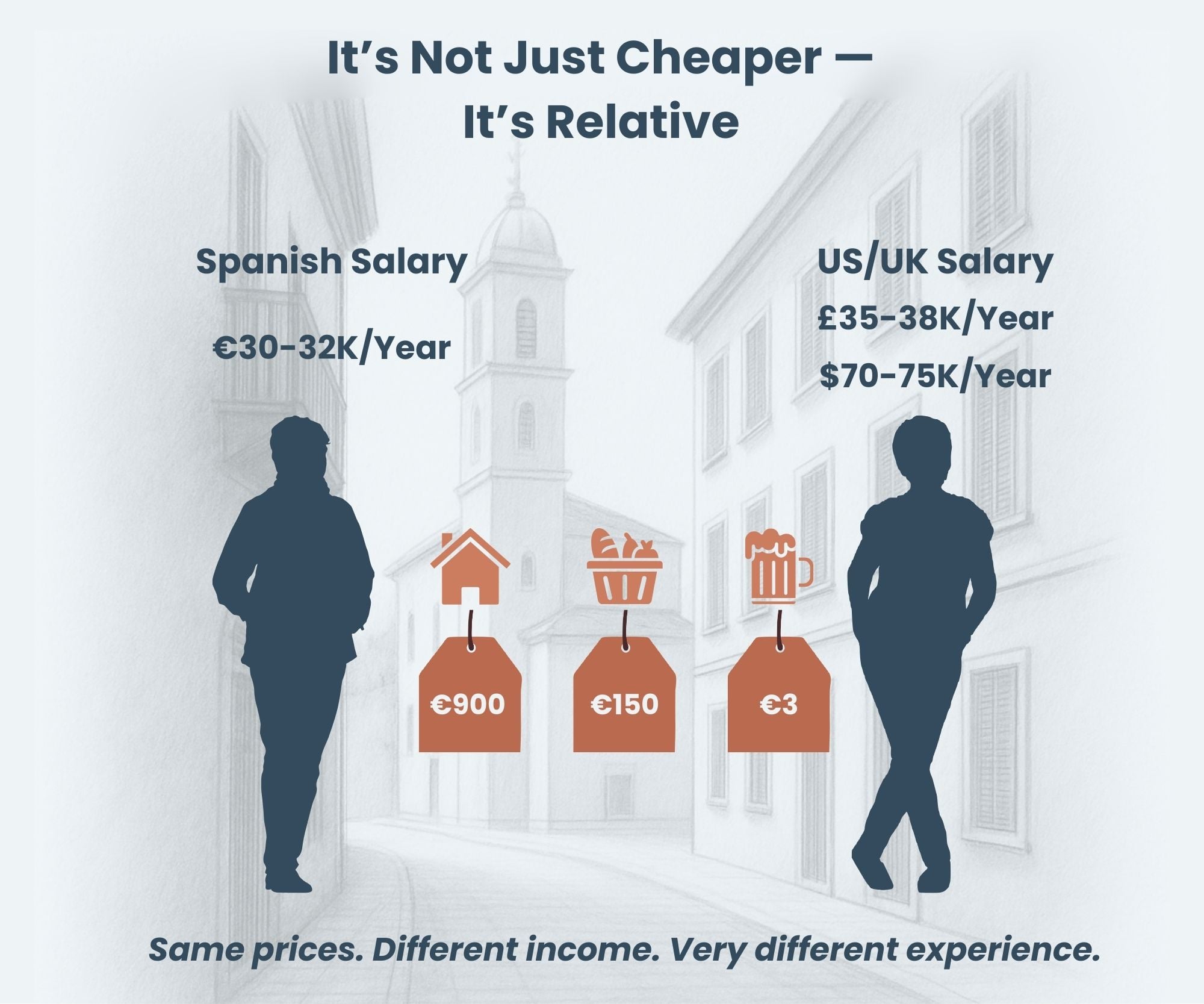
The disconnect isn’t about prices alone. It’s about prices relative to income. Spain’s average wages are significantly lower than those in the US and the UK, so for the average Spanish wage earner, Spain’s recent inflation has really hurt. For Expats earning US- or UK-level salaries or pensions, the situation is very different.
Average Wages and Spending Power: Spain vs. the US vs. the UK
| Metric (National Average) | Spain (Local) | Spain (USD) | United States (USD) | United Kingdom (Local) | UK (USD) |
|---|---|---|---|---|---|
| Average gross annual salary | €30–32K | $32–35K | $70–75K | £35–38K | $44–48K |
| Average gross monthly salary | €2.5–2.65K | $2.7–2.95K | $5.8–6.25K | £2.9–3.15K | $3.65–4.0K |
| Cost of living index (US = 100, PPP) | 72–75 | 72–75 | 100 | 93–96 | 93–96 |
| Relative prices vs Spain | Baseline | Baseline | +35% | +15–20% | +15–20% |
| Indicative spending power* | Low–Moderate | Low–Moderate | High | Moderate | Moderate |
Important: Indicative spending power reflects how far an average salary goes against average prices, excluding tax and healthcare. These are national averages and exclude tax and healthcare. They illustrate why perceptions differ, not what any individual earns.
What Are the Most Common Cost of Living Mistakes When Moving to Spain?
When we speak with clients planning their new Spanish budgets, this is the idea we consistently try to convey. Where and how you live affects how much your life in Spain will cost.
If you move from a small town in Arkansas to central Madrid, go from working to playing golf three times a week and eating out every night, then… yup, your cost of living in Spain will be higher than your old life!
Comparing Spain to New York, San Francisco, or London almost always makes Spain look dramatically cheaper. While that comparison isn’t wrong, it’s often incomplete. Most people are not moving from Manhattan to central Madrid, or from Zone 1 London to Barcelona’s Gothic Quarter.
A more useful comparison is:
- Where do you actually live now
- Versus the type of city you’re likely to live in Spain
When you compare like-for-like (by property type, density, access, and neighborhood quality), the savings remain real but are usually less extreme.
Why Cost of Living Is Not a Fixed Number
Many people treat the cost of living as a static figure: “Spain costs €X per month.”
That mindset leads to disappointment. In reality, your cost of living in Spain will change with your:
- City choice
- Housing type
- Household size
- Transport habits
- Lifestyle density
Our son finishes school in 2026 and is taking a gap year (and hopefully earning some cash!). Where and how we spend our money will change significantly. Remember, two people living in the same city can have very different costs depending on how they live.
“Living in Málaga City can be more premium. It is a working city, people need to live here because they work here, and that puts real demand on supply. As we move out, even just 15 minutes, we start to see prices tail off. You can save €200 to €300 a month by going one or two towns out. Until you hit Marbella, and when you hit Marbella, you are back above Málaga prices.” Carin Cowell, Málaga Rental & Property Expert, Moving to Spain Webinar, April 2026
Our Multi-City Spain Cost of Living Calculator helps you see where your money goes!
Is Spain Cheaper for You? (Scenario-Based Reality Check)
We’ve put together a table to help identify who the biggest budget winners and losers are with a move to Spain. This is based on conversations we’ve had with hundreds of clients over many years.
| Scenario | Is Spain Likely Cheaper? | Why |
|---|---|---|
| US remote worker (US salary) | Yes | US income + Spain’s lower housing, food, and transport costs typically increase spending power significantly, especially outside Madrid and Barcelona. |
| US retiree (pension + Social Security) | Yes | Fixed USD income stretches further on everyday costs; healthcare and tax need separate planning, but day-to-day living is usually cheaper. |
| US professional relocating for a Spanish job on a Spanish salary | Often no | Spanish salaries are much lower; lower prices rarely offset the income drop unless lifestyle expectations change. |
| UK renter (London or South East) | Yes | Short-term mover/trial year |
| UK homeowner outside London | It depends | If current housing costs are low, Spain may not be cheaper unless moving to a lower-cost Spanish city. |
| UK retiree (state + private pension) | Mostly yes | Pension income combined with lower everyday prices usually improves affordability, especially in secondary cities. |
| Spanish-salary earner | Usually no | Savings on food and transport may be offset by higher rents in family-sized properties in popular cities. |
| Family needing a large rental | It depends | Digital nomad/freelancer (variable income) |
| Short-term mover/trial year | Sometimes | Spain can be cheaper in low-cost cities, but income volatility and housing choice matter more than national averages. |
| Short-term mover / trial year | Often no (initially) | Setup costs, deposits, and short-term rentals can make the first year more expensive even if long-term costs are lower. |
| Lifestyle-driven mover (slower pace, fewer purchases) | Almost always yes | Spain rewards lower-consumption lifestyles; savings come from how you live, not just where you live. |
How to Use This Table Correctly
- “Yes” does not mean “cheap.” It means cheaper than where you’re coming from.
- “It depends” usually means housing choice is decisive.
- Income source matters more than nationality.
Spain is cheaper for people bringing income with them, mixed for people changing jobs, and often not cheaper for people earning average Spanish salaries.
Final Reality Check
Spain’s cost advantage is real but conditional.
It depends on:
- Where your income comes from
- What size and type of housing do you need
- Which city will you choose
- How you live day to day
That’s why this guide gives you the context, and the calculator does the actual work.
Why Aren’t Taxes and Healthcare Included in This Cost-of-Living Guide?
Your cost of living in Spain will change dramatically depending on your tax and healthcare situation. And, giving simple answers to how is tricky. Move from the US, and you’ll pay a fraction of your current healthcare bill (as low as 10%)! If you are coming from the UK and receive free care from the NHS, then your bill is going up! Tax is similar – what income do you earn, what is your tax status in Spain, and what do you play today?
Why Tax Is Excluded
Tax depends on your personal situation, not the country’s average. In Spain, outcomes vary by:
- Tax residency
- Income source (employment, self-employment, pensions, investments)
- Where income is earned
- Family circumstances
- Autonomous community (regional differences)
Two people with identical living costs can pay very different taxes. Any “average tax” in a cost-of-living figure is guesswork.
>> For accurate, personalized guidance, see: https://movingtospain.com/finances/tax/
Why Healthcare Is Excluded
Healthcare costs are driven by access and risk, not typical monthly spend. They depend on:
- Visa and residency status
- Employment status
- Age and medical history
- Eligibility for public healthcare vs private insurance requirements
Note: Our US clients who pay for American Private Health Insurance are always amazed at how comparatively cheap private health insurance is in Spain. It is not uncommon to get full coverage for 10% of the cost of the same coverage in the US, and your Spanish insurance has zero co-payments. This massive cost difference is a defining highlight of the American expat experience.
“Our annual policy for the three of us is €1,800. A family of five on premium cover with no co-payments is €3,341 for the year. These are genuine quotes from our partners, issued in the last two months, from insurers that meet the immigration standards. A retired couple aged 64 and 63 on premium cover would pay more than a family of five with two middle-aged parents and three young children.” Alastair Johnson, Co-founder, Moving to Spain, Cost of Living Across Spain Webinar, April 2026
# Spain, the UK, and the US use fundamentally different systems, so rolling them into one number would be misleading.
>> To find out how much healthcare in Spain will change your budget, see: https://movingtospain.com/living-in-spain/healthcare/
Action >> Get a Spanish Private Health Insurance Quote Today
“He has rheumatoid arthritis. The normal cost if you bought it privately per month is about €1,500. If you’re in the US, the over-the-counter equivalent is something like $5,000 or $6,000 a month. He goes to the public healthcare system in Spain and pays nothing. Zero.” Alastair Johnson, Co-founder, Moving to Spain, Cost of Living Across Spain Webinar, April 2026
Our Final Take on the Cost of Living in Spain
We moved from Sydney, Australia, to a small town outside Barcelona in 2015, and we couldn’t believe how little we spent every month. Rent was a fraction of Sydney’s costs; a three-course menu del dia with wine was €12, and a beer cost just €1.20 in our local pub. Our private health insurance with no co-payments costs half as much as it did in Australia. Since 2015, we’ve become used to Spanish prices, and so it doesn’t feel as cheap as it did when we arrived. Inflation has played a part and is really noticeable everywhere, from supermarkets to restaurants.
But when we travel to the US, the UK, and Australia, we get a reality check – life in Spain is still much cheaper for us than the equivalent life in any of those countries. And, we get to live in this magnificent country!
Spain Cost of Living FAQ
Methodology: How This Article Compares Spain vs the US vs the UK (and How to Reproduce It)
Note: AI tools (ChatGPT and Gemini) were used for research and some text in this article. All data was manually checked by the Moving to Spain research team.
What this article measures
This article compares national-level cost-of-living price levels and inflation trends across Spain, the United States, and the United Kingdom using official, internationally comparable statistics. All figures, ranges, and conclusions used in the article are directly supported by the sources listed below and are consistent with the data presented in the tables and charts.
The methodology supports the article’s core findings:
- Spain’s overall price level is ~25–28% lower than the US (US = 100; Spain ~72–75, PPP-adjusted)
- Spain’s overall price level is ~12–15% lower than the UK (UK = 100; Spain ~85–88, PPP-adjusted)
- Prices in Spain have risen, but not faster than in the US or the UK over 20-, 10-, and 5-year periods
- Housing is the single largest driver of cost-of-living differences
What this article explicitly excludes
Tax and healthcare are intentionally excluded from all cost-of-living comparisons because they are status- and system-dependent outcomes rather than comparable consumer price baskets. They are covered separately:
- Tax: https://movingtospain.com/finances/tax/
- Healthcare: https://movingtospain.com/living-in-spain/healthcare/
This article answers “How expensive are everyday goods and services?”
It does not answer “What will my personal monthly budget be?”
How We Compare Overall Cost-of-Living Between Countries
All headline country-to-country comparisons use Purchasing Power Parities (PPPs) and Price Level Indices (PLIs) produced by the OECD and Eurostat. These indicators are specifically designed to compare national price levels without distortion from exchange rates.
Official sources
- OECD PPP indicator overview: https://www.oecd.org/en/data/indicators/purchasing-power-parities-ppp.html
- OECD PPP datasets (download access): https://www.oecd.org/en/data/datasets/purchasing-power-parities.html
- OECD Data Explorer (PPP detailed results): https://data-explorer.oecd.org/
- Eurostat PPP methodology and PLIs: https://ec.europa.eu/eurostat/web/purchasing-power-parities/information-data
How the article’s PPP figures are derived
- Use the latest available OECD PPP dataset.
- Select Price Level Indices for household final consumption (or equivalent actual individual consumption).
- Set one country as the baseline (US = 100 or UK = 100, as stated).
- Read Spain’s index value and calculate the percentage difference.
This produces the Spain ~72–75 vs US = 100 and Spain ~85–88 vs UK = 100 values used throughout the article.
How inflation over 20, 10, and 5 years is measured
Inflation is used to contextualize the claim that “Spain isn’t as cheap as it used to be” and to show that the US and UK experienced equal or higher cumulative inflation.
Price levels (PPP) and inflation (CPI/HICP) measure different things:
- PPP/PLI compares prices across countries at a point in time
- Inflation indices measure how prices change within a country over time
Spain inflation (official)
- INE CPI (IPC) latest data and methodology:
https://www.ine.es/dyngs/INEbase/operacion.htm?c=Estadistica_C&cid=1254736176802&idp=1254735976607&menu=metodologia
Harmonized EU comparator (used for cross-country consistency)
- Eurostat HICP methodology:
https://ec.europa.eu/eurostat/cache/metadata/en/prc_hicp_esms.htm - Eurostat HICP database:
https://ec.europa.eu/eurostat/web/hicp/database - Eurostat HICP annual rate of change:
https://ec.europa.eu/eurostat/databrowser/product/view/prc_hicp_manr
United Kingdom inflation
- ONS CPI/CPIH datasets:
https://www.ons.gov.uk/economy/inflationandpriceindices/datasets/consumerpriceindices - ONS CPIH time series:
https://www.ons.gov.uk/datasets/cpih01/editions/time-series
United States inflation
- BLS CPI overview:
https://www.bls.gov/cpi/ - BLS CPI data access:
https://www.bls.gov/cpi/data.htm - CPI-U All Items series (CUUR0000SA0):
https://data.bls.gov/timeseries/CUUR0000SA0
How cumulative inflation is calculated
For each country and period (20/10/5 years):
- Use the official CPI index
- Calculate cumulative change as:
(Index_end ÷ Index_start − 1) × 100 - Report results as rounded ranges to account for minor differences between annual averages and year-end values
This method directly supports the inflation ranges shown in the article tables.
How housing and rent claims are supported
Housing is treated separately because it is the largest contributor to household costs and the biggest source of variation between countries and cities.
The article avoids false precision and instead uses directional ranges, supported by official housing indicators.
Official sources
- OECD Housing Prices indicators:
https://www.oecd.org/en/data/indicators/housing-prices.html - OECD Affordable Housing Database:
https://www.oecd.org/en/data/datasets/oecd-affordable-housing-database.html - Eurostat HICP detailed index (includes “Actual rentals for housing”):
https://ec.europa.eu/eurostat/databrowser/product/view/prc_hicp_midx - Eurostat housing cost overburden rate:
https://ec.europa.eu/eurostat/databrowser/view/tespm140/default/table?lang=en
These sources underpin statements such as:
- Spain’s lower average rent levels compared to the US and UK
- Wider internal rent dispersion within Spain
- Housing’s outsized impact on affordability
How wages and “spending power” are handled
Wage data is used only to explain perceptions, particularly why Spain may feel cheap to expats but expensive to locals. Wages are not included in cost-of-living totals.
Official wage sources
- OECD Average Annual Wages:
https://www.oecd.org/en/data/indicators/average-annual-wages.html - Spain INE Salary Structure Survey (EAES):
https://www.ine.es/dyngs/Prensa/en/EAES2023.htm - UK ONS Annual Survey of Hours and Earnings (ASHE):
https://www.ons.gov.uk/employmentandlabourmarket/peopleinwork/earningsandworkinghours/bulletins/annualsurveyofhoursandearnings - US BLS Current Employment Statistics (earnings context):
https://www.bls.gov/ces/
“Indicative spending power” in the article is a qualitative interpretation of wage levels relative to PPP-adjusted prices, not a disposable-income model.
How currency conversions are handled
Currency conversion is used only where the article displays local currency alongside USD for reader clarity. Exchange rates are not used for international cost-of-living comparisons.
Official reference sources
- European Central Bank exchange rates:
https://www.ecb.europa.eu/stats/policy_and_exchange_rates/euro_reference_exchange_rates/html/index.en.html - Bank of England exchange rates:
https://www.bankofengland.co.uk/boeapps/database/Rates.asp - US Federal Reserve H.10 FX rates:
https://www.federalreserve.gov/releases/h10/
Data freshness and reproducibility
All datasets used are the latest full official releases available at the time of writing and are appropriate for 2026 planning, recognizing unavoidable publication lags in PPP and CPI data.
Readers can reproduce every figure by:
- Accessing the OECD PPP datasets via the Data Explorer
- Pulling CPI/HICP series from the national statistical offices listed above
- Applying the same index baselines and cumulative inflation calculations described here
Known limitations
- National averages cannot predict individual household budgets
- Rent comparability varies due to tenure structures and measurement differences
- PPP and CPI reflect broad baskets, not individual lifestyle choices
These limitations are why this article provides context, and the companion Spain cost-of-living calculator provides personalized modeling based on explicit assumptions.







I really want to move to Spain
I want to move to Alicante in 2025. I want to rent an apartment with three or four bedrooms near the water or nice place where it’s easy to get to train station and city center.
I am trying to plan my family’s move and rather a smaller town just with transportation abilities to major city of Madrid. But can’t seem to find websites to show me housing.
Hi Jenny – https://www.idealista.com/en/ is a good place to start. Also check out our Destinations portal which has lots of advice. All the best, Alatsair https://movingtospain.com/destinations/