

Most non-EU newcomers to Spain need private health insurance for their visa, with no copayments or waiting periods. Every car and electric scooter needs third-party liability cover, and a mortgaged home needs building insurance. Contents, life, travel, and most pet cover are optional. Liability cover for every dog becomes compulsory once Spain approves the regulation under its animal welfare law (Ley 7/2023).
This Spain insurance guide covers each type of insurance, what Spanish law requires, and what to check before you buy.
Which insurance is compulsory in Spain?
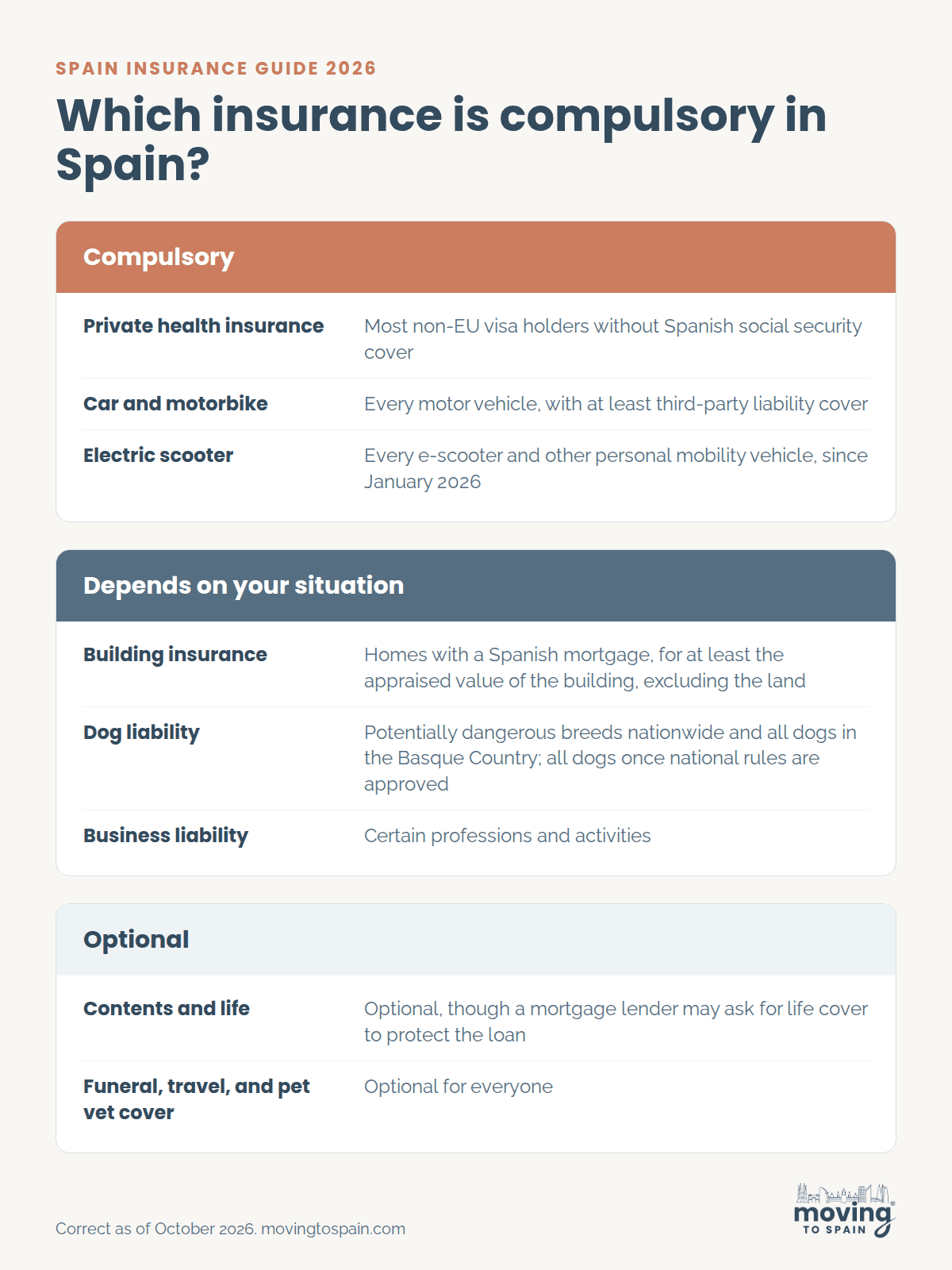
Only a few types of insurance are compulsory in Spain, and each depends on your situation rather than on residence alone.
| Insurance | Compulsory? | Who it applies to |
|---|---|---|
| Private health insurance | Yes, for most non-EU visa holders | Visa applicants without Spanish social security cover |
| Car and motorbike | Yes | Every motor vehicle, with at least third-party liability cover |
| Electric scooter | Yes, since January 2026 | Every electric scooter and other personal mobility vehicle |
| Building insurance | Yes, if mortgaged | Homes with a Spanish mortgage, insured for at least the appraised value of the building, excluding the land |
| Dog liability | Partly | Compulsory for potentially dangerous breeds nationwide and all dogs in the Basque Country; all dogs once the national regulation is approved |
| Business liability | Sometimes | Certain professions and activities |
| Contents, life, funeral, travel, pet vet cover | No | Optional for everyone |
Do I need private health insurance in Spain?
Most people moving to Spain from outside the EU need private health insurance for their residence visa. For a visa, the policy must give full cover with no copayments and no waiting periods, from an insurer authorized in Spain. After a year of legal residence, many people can join the public system through a pay-in scheme called the convenio especial. UK state pensioners can usually register an S1 form instead.
Our guide to health insurance for residency and visas explains the requirements in detail. See also our guides to the S1 form and public healthcare.
1,500+ clients insured with compliant healthcare policies
Our specialists compare policies that meet visa rules and send you up to three quotes from one form.
Health insurance is arranged through licensed insurance brokers.
What car insurance do I need in Spain?
Third-party liability insurance is compulsory for every motor vehicle in Spain. Basic third-party cover (terceros básico) pays for injury and damage you cause to others, but it does not cover fire or theft of your own car. Extended third-party cover (terceros ampliado) usually adds theft, fire, and broken glass. Fully comprehensive cover (todo riesgo, literally “all risk”) also pays for damage to your own car.
Our guide to car insurance in Spain explains the policy types and prices.
Our specialists can quote car and motorbike insurance for Spanish-registered vehicles.
Car insurance is arranged through licensed insurance brokers.
Do electric scooters need insurance in Spain?
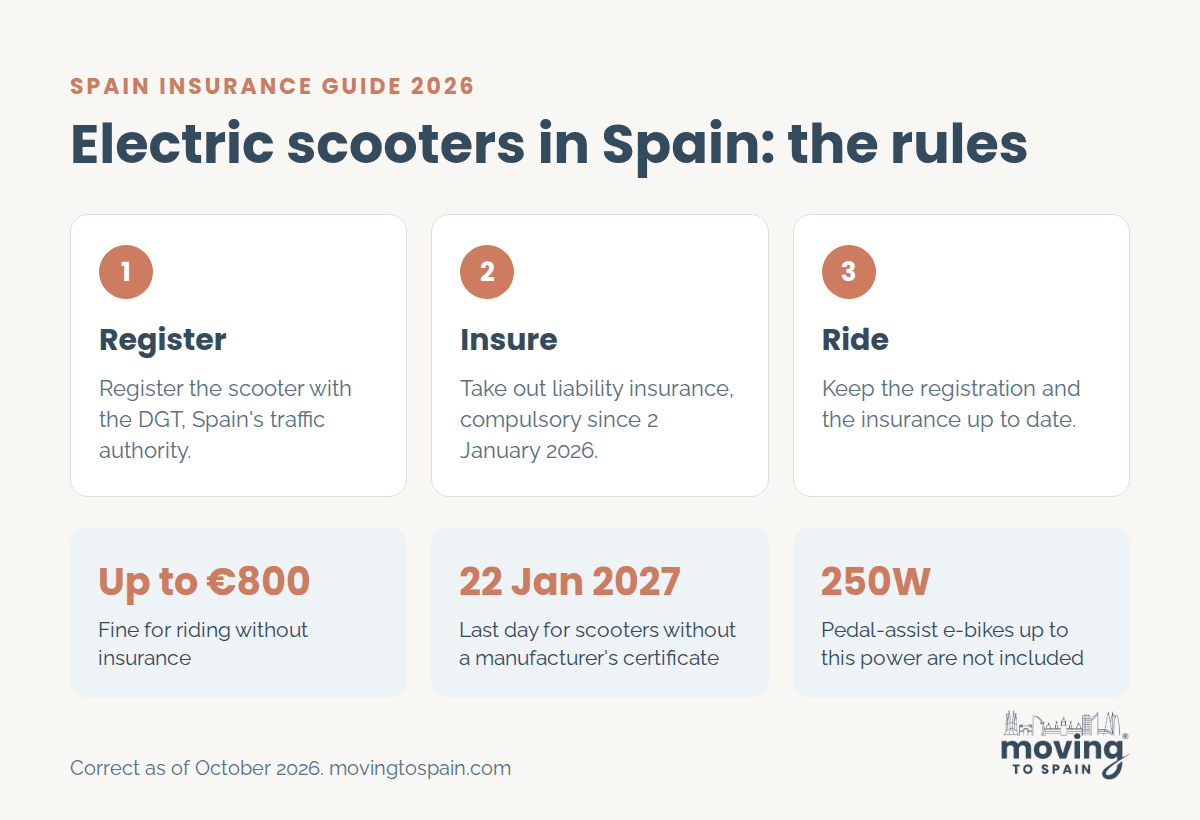
Yes. Since 2 January 2026, electric scooters and other personal mobility vehicles must have their own liability insurance. You have to register the scooter with Spain’s traffic authority, the DGT, before you can insure it. Riding without insurance can bring a fine of up to €800. Scooters without a manufacturer’s certificate can only be used until 22 January 2027. Pedal-assist electric bikes with a motor of 250W or less are not included.
Do I need home insurance in Spain?
Home insurance is not compulsory if you own your home outright. If your home has a Spanish mortgage, the law requires insurance against damage for at least the appraised value of the building, excluding the land. Your appraisal report shows this figure as the insurance value (valor de seguro). Your lender can require this cover but cannot make you buy its own policy, and it must accept an equivalent policy from another insurer. Note that if the bank gave you a lower interest rate for taking its policy, switching can mean losing that discount.
Our guides to home insurance and to Spanish mortgages cover the details.
Our specialists can quote home insurance for owners, landlords, and second homes.
Home insurance is arranged through licensed insurance brokers.
Who pays for flood damage in Spain?
The Consorcio de Compensación de Seguros, a public body, pays for damage from extraordinary events such as river flooding, earthquakes, and atypical cyclonic storms. It is funded by a surcharge on home, car, and business policies, so you can only claim if you had a policy in force when the damage happened. Damage from ordinary rain, leaks, or hail depends on your own policy.
To claim, apply on the Consorcio website or call its free line on 900 222 665, Monday to Friday from 9am to 6pm. Staff also speak English. Your insurer or broker can file the claim for you. The Consorcio applies no deductible (franquicia) to damage to homes or vehicles, even if your own policy has one for ordinary claims. Damage to other property, such as business premises, carries a 7% deductible. The Consorcio pays out on the terms of your own policy, so the amount your policy insures matters.

Is pet insurance compulsory in Spain?
For most dogs, not yet. Spain’s animal welfare law (Ley 7/2023) requires every dog owner to have third-party liability insurance, but the rule cannot apply until the government approves the regulation setting the minimum cover. That regulation was still pending in October 2026.
However, liability cover is already compulsory nationwide for breeds classed as potentially dangerous, with the amount of cover varying by region. The Basque Country requires insurance for all dogs, but it is unique among the autonomous communities, most of which are still awaiting national legislation. When choosing where to live with your dog, check the current situation in your target area.
Many home insurance policies include liability cover for pets if you declare them, so check yours before buying a separate policy. Liability-only cover for a dog costs around €38 a year on average. Vet cover for illness and accidents is optional.
Do I need life or funeral insurance in Spain?
Life insurance in Spain (seguro de vida) pays a lump sum to the people you name if you die during the policy term. It is optional, but a mortgage lender may ask for a policy that protects the loan. As with home insurance, you can buy that policy from any insurer offering equivalent cover.
Funeral insurance (seguro de decesos) is common in Spain. It pays for the funeral and, on many policies, repatriation to your home country. Check whether repatriation is included before you buy. Our guide to life insurance in Spain explains the options.
Do residents need travel insurance?
Travel insurance is optional for residents, and a travel policy never meets the requirements for a residence visa. If your nationality needs a Schengen visa to visit Spain, you must show travel medical insurance with at least €30,000 of cover valid across the Schengen Area. US and UK citizens don’t need a visa to visit Spain or the rest of the Schengen Area for up to 90 days in any 180-day period.
Do autónomos need business insurance?
Spain has no general rule that every business or self-employed worker (autónomo), including people on a Digital Nomad Visa, must hold liability insurance. It is compulsory in specific professions and activities, such as law, architecture, healthcare, travel agencies, and some construction work. Some town halls (ayuntamientos) also require it before they license business premises. Your professional association and town hall can tell you what applies.
What does Spanish social security cover?
Social security contributions give access to public healthcare, sick pay, a state pension, and, for employees, unemployment benefit. Note that autónomos have a separate route to unemployment benefit via cese de actividad.
Our guide to public healthcare in Spain explains how to register for public healthcare at your local health center.
How do I renew, switch, or cancel insurance in Spain?
Most Spanish insurance policies renew automatically every year. To cancel at renewal, tell your insurer in writing at least one month before the renewal date. If you don’t, it is likely your policy will renew automatically. Your insurer must tell you about any change to the policy, including a price increase, at least two months before renewal.
If your residence permit depends on private health insurance, arrange any new policy before the old one ends. A gap in cover can cause problems when you renew your permit.
Your next step
Not sure which policies apply to your move? Start with health insurance, because your visa depends on it.
Frequently asked questions
What insurance do I need as an Expat in Spain?
Most newcomers from outside the EU need health insurance that meets visa rules. Car insurance is compulsory for any vehicle you own, including an electric scooter, and building insurance for a mortgaged home. Most other cover is optional.
Can I use my home country’s insurance in Spain?
Usually not for residence. For a Spanish visa, your health policy must come from an insurer authorized in Spain and meet the visa conditions. Home-country car insurance is not a long-term option once your car must be registered in Spain.
Can I cancel health insurance during the policy year?
Check your policy terms first. If your residence permit depends on the policy, have a new compliant policy in place before you cancel, so there is no gap in cover.
Is cat insurance compulsory in Spain?
No. The liability insurance requirement in Spain’s animal welfare law applies to dogs. Vet cover for cats is optional.