
Being over 75 does not rule you out of private health insurance in Spain. Fewer insurers offer cover at this age, and underwriting is stricter, but suitable, residency-compliant policies are still available in most cases. With our specialist partners, we help older clients arrange qualifying cover every week. This guide explains how to get health insurance in Spain for over 75s, what it costs, and how to apply with the best chance of success.
Is It Possible to Get Health Insurance in Spain After Age 75?
“Age is not the barrier people expect. Most applicants over 75 can still get private cover that meets Spanish visa and residency rules. Once you pass 80 the choice of insurers narrows and premiums rise, but in most cases we can still find a policy that works, sometimes through a specialist insurer rather than a standard plan.” Ciarán O Toole, Spain Health Insurance Specialist
Yes. In most cases, people over 75 can still get private health insurance in Spain that meets residency and visa requirements. Spanish immigration rules set no upper age limit, so age alone does not disqualify you. The decision sits with insurers, who issue fewer policies and apply stricter underwriting as applicants get older, which is why two people of the same age can get very different answers depending on how and where they apply.
Need Spain Private Health Insurance?
We constantly monitor the market and recommend only insurers whose policies meet visa requirements for all of our clients and who are recommended by friends and the community.
one form – up to three quotes. EASY!
Why Age Alone Does Not Close the Door
Age, by itself, is not the deciding factor. Insurers look at a combination of age, overall health, medical history, and policy structure. We regularly see applicants in their late seventies accepted for cover when their circumstances are assessed carefully and the application is placed with the right insurer.
Problems tend to arise when age is treated as a blanket barrier rather than one factor among several. This is often why people are told “it’s not possible” after a single enquiry, even though other options may still exist.
What Typically Changes After 75
While cover may still be available, applicants over 75 should expect some differences compared to younger age groups.
There are usually fewer insurers to choose from; medical questionnaires are more detailed; underwriting decisions take longer; and premiums are higher. Some policies may also include stricter conditions, so it is essential to ensure that any offer aligns with your broader plans in Spain. Remember that Spanish private healthcare policies for immigration, residency, and visa applications have strict eligibility requirements.
Understanding these changes early helps set realistic expectations and avoids frustration later. The aim is not to find any policy, but to find one that genuinely works for your situation and supports your move to Spain.
How Much Does Health Insurance Cost After Age 75?
Private health insurance in Spain after 75 typically costs between €2,000 and €5,500 a year, rising with age and depending on your health. For applicants over 75 in good health, expect approximately:
- Age 75–76: €2,000–€4,200 per year
- Age 77–79: €4,000–€5,000 per year
- Age 80+: From €4,500 per year, where cover is available
Note: These figures are 2026 quoting ranges supplied by our specialist insurance partner, not survey data. Your own quote will depend on your age, your medical history, and which insurers will take you.
Pre-existing conditions can add 10%–30% to these figures. Couples policies are typically 10–20% cheaper per person than two individual policies.
For the full cost table by age and household type, see our pillar guide: Health Insurance in Spain >> The Complete Guide for International Movers.
Why So Many People Are Told Health Insurance Over 75 Is “Impossible”
Many people over 75 are told very quickly that private health insurance in Spain is no longer available. This advice often comes early in the process and is delivered with confidence, which is why it is so discouraging. In most cases, however, it is based on a partial view of the market rather than a complete assessment of what is actually possible.
We see this most often among people who contact a single insurer, a general broker, or rely on informal online advice. When the first answer is no, it is easy to assume there are no alternatives.
Age Limits Used by Many Spanish Insurers
Many Spanish private health insurance companies do apply maximum entry ages, commonly between 65 and 75. If enquiries stop with those insurers, the conclusion seems straightforward.
What is less well known is that a smaller number of insurers are prepared to consider applicants aged 75 and over, including those in their late seventies. These insurers tend to work with more detailed underwriting and are often more selective, but they do exist. Accessing them usually requires experience with Expat applications and an understanding of how to present the case properly.
This is one of the reasons we focus on Expat-experienced insurers rather than the broader market. It is not about finding any policy, but about finding one that is realistic for your age and circumstances.
The Difference Between Commercial Insurance and Residency-Compliant Cover
Another common source of confusion is the distinction between commercial insurance and insurance that actually works for a move to Spain.
Some senior health insurance products are designed for people who are already resident in Spain and using the healthcare system. Others include exclusions, waiting periods, or cost-sharing that make them unsuitable if you need insurance for residency purposes. We cover this distinction in more detail in our main guide to Spanish health insurance for residency and visas, which explains what immigration authorities look for and why some policies fail even though they appear comprehensive.
When this difference is not clearly explained, people are told insurance is available, only to learn later that it cannot be used for their application. At that point, time and money have often already been lost.
Why Incomplete Advice Leads to Dead Ends
Most people who are told health insurance is impossible over 75 were not given bad advice deliberately. They were given advice based on limited insurer access, assumptions about age limits, or a lack of focus on how insurance fits into a move to Spain.
When the process is approached with a clear understanding of both insurer underwriting and the broader residency context, outcomes often differ significantly. This is especially true when age is considered alongside overall health rather than treated as a single deciding factor.
How Health Insurance for Over 75s Works in Practice
Once age becomes a factor, the way health insurance works in practice often differs from what people expect. The key point is that insurance underwriting and Spanish residency rules are separate processes, even though they interact.
Insurers decide whether to offer cover and on what terms. Immigration authorities then assess whether the policy meets the legal requirements for a move to Spain. Confusion arises when these two steps are blurred together.
Underwriting Decisions Versus Immigration Requirements
Insurance companies assess applications based on age, medical history, and overall risk. For applicants over 75, this usually means more detailed medical questionnaires and a closer review of health history. Some applications are accepted quickly, others take longer, and some are declined.
Spanish immigration authorities do not take part in this process. They do not review medical histories or underwriting decisions. They look only at whether the insurance policy presented meets residency standards. We explain the standards in full in our main guide to Spanish health insurance for residency and visas, which we recommend reading alongside this article if you are still planning your wider move.
Understanding this separation helps avoid a common mistake. A declined insurance application does not mean residency is impossible. It means a different insurer or a different approach may be needed.
Why Acceptance Depends on Structure, Not Just Age
At this stage, the policy structure matters as much as the applicant’s age. Some insurers will only offer older applicants a policy with exclusions, waiting periods or cost sharing. Those policies may be perfectly good healthcare. They will not satisfy a visa application, because a compliant policy cannot carry exclusions any more than it can carry copayments or waiting periods. If you need the policy for residency, an exclusion is not a workable outcome, so what matters is finding an insurer willing to cover the condition rather than one willing to write it out.
This is why experience with Expat cases matters. Insurers that regularly work with older Expats understand when a policy needs to meet immigration standards and how to structure cover accordingly. Without that context, applicants are often offered policies that appear suitable but later cause problems.
Realistic Outcomes for Applicants Aged 75 to 80
In our experience, our partners working with clients between 75 and 80 see a range of outcomes. Most obtain cover; some with higher-than-expected premiums, others with straightforward terms. A smaller number are declined based on medical history rather than age alone.
What makes the most significant difference is timing and preparation. Applicants who confirm eligibility early, before committing to visa timelines or property plans, tend to have clearer options and fewer surprises. Those who leave insurance until the last moment often find themselves under unnecessary pressure.
When Private Health Insurance Is Required for Over-75s Moving to Spain
For most people over 75, private health insurance is required when moving to Spain. This is not due to age, but to how Spanish residency rules apply at the time of application.
Spanish immigration authorities assess your healthcare situation at the time of your application, not what may apply later. At that stage, most older applicants do not yet qualify for public healthcare and must rely on private insurance.
Public Healthcare and Why It Rarely Applies at the Start
Spain’s public healthcare system is excellent, but access is limited to those who contribute to the Spanish Social Security system. Most people only qualify once they are working, registered as self-employed, or have a recognised entitlement from another country.
For retirees moving to Spain, those routes are rarely available at the application stage. This is why Spanish public healthcare is often not sufficient to meet residency requirements initially. We explain this in more detail in our overview of healthcare in Spain, which sets out who qualifies and when.
The Convenio Especial and Why It Comes Later
Some of our clients later access public healthcare through the Convenio Especial, a monthly contribution scheme that allows Expats to buy into the Spanish system.
However, this option is not available immediately. You generally need to be a legal resident in Spain for a period of time before you can apply. For people over 75, this means the Convenio Especial does not remove the need for private insurance when first applying for residency.
Our comprehensive guide to the Convenio Especial in Spain explains how it works and when it becomes available.
S1 Forms and When They Apply
Some pensioners can use an S1 form to access Spanish public healthcare, most commonly UK and specific EU state pension recipients. When registered correctly, you can use an S1 to meet residency healthcare requirements.
However, S1 forms do not apply to everyone, and they are not available to US retirees. Even for those who qualify, the S1 must be issued and registered before it can be relied upon.
We cover eligibility and registration in our guide to S1 forms for Spain.
How This Affects Most Applicants Over 75
For most people over 75 planning a move to Spain, private health insurance is the practical starting point. Public healthcare, the Convenio Especial, or an S1 may become relevant later, but they rarely resolve the issue at the application stage.
Which Spanish Insurers Offer Health Insurance for Over 75s?
Maximum entry ages across the insurers we track run from 70 to 80. For applicants of 75 and over, the field narrows sharply. Above 79, it narrows to a single route.
ASSSA: the specialist for over-75 applicants
ASSSA accepts new applicants up to age 74 as standard, with case-by-case acceptance up to age 79. Their network is strongest on the Costa Blanca and the Mediterranean coast and operates in the Canary Islands. It does not operate in the Balearic Islands, the Basque Country or Sevilla.
Sanitas: an option if you’re under 76
Sanitas accepts new applicants up to age 75. If you’re applying before your 76th birthday and don’t have complex pre-existing conditions, Sanitas is often the strongest premium-tier option, particularly in Madrid, Barcelona, or other major cities.
DKV: the route above 75
DKV writes a first policy from age 76 to 99, and only within that band, so it is not an option below 76. Pre-existing conditions are assessed case by case and can be covered.
Asisa: Entry age 70
A specialist route accepts first policies up to age 80 and requires a medical report from 75.
Why Market Knowledge Matters More Than Names
Insurers move in and out of the over-75s market. Entry ages, underwriting thresholds, and policy structures can change with little notice. Advice that was accurate even a few months ago may no longer apply.
This is why working with services that actively track the market and stay aligned with changing offers and conditions matters. Knowing which insurers are open to applications, the conditions they apply, and how they currently assess risk makes a real difference at this stage.
Request quotes from our expert partners who actively track the over-75s market.
How Pre-Existing Conditions Affect Health Insurance for Over 75s
Pre-existing medical conditions become more relevant as age increases, but they do not automatically rule out private health insurance in Spain. What matters is how insurers assess risk and how any conditions affect the policy’s structure.
For people over 75, this assessment tends to be more detailed, and outcomes can vary significantly between insurers.
How Medical History Is Assessed at Older Ages
Insurers ask more detailed questions once an applicant reaches their mid-seventies. This typically includes information on ongoing conditions, recent diagnoses, medications, and prior treatments.
Outcomes generally fall into a small number of categories. Some applicants are accepted on standard terms; others are offered coverage with adjusted premiums; and some are declined based on their overall risk profile rather than a single condition.
Insurers, not immigration authorities, make these decisions. Understanding this distinction helps avoid unnecessary worry about how medical history affects a move to Spain.
Why Some Policies Cannot Be Used for Residency
In some cases an insurer will offer cover, but only with an exclusion or a waiting period for your pre-existing condition. That policy will not satisfy a residency or long-stay visa application. There is no “usually” about it: an exclusion breaks compliance. The outcome you need is an insurer willing to cover the condition.
This is where people often encounter problems late in the process. A policy exists, but it does not meet immigration standards. Our separate guide to health insurance in Spain with pre-existing conditions explains this in more detail and outlines which policy features are acceptable and which are not.
Why Eligibility Should Be Checked Early
For applicants over 75, checking insurance eligibility early is especially important. Medical underwriting takes longer at this age, and options can narrow quickly once an application has been declined.
Confirming whether suitable cover is available before committing to visa timelines or property plans helps avoid unnecessary pressure and sets realistic expectations from the outset.
What to Look for in a Residency-Compliant Policy for Over 75s
Once you reach your mid-seventies, not every available health insurance policy will be suitable for your broader plans in Spain. The goal is not simply to obtain coverage, but to choose a policy that works for both healthcare access and, where relevant, residency requirements.
Focusing on the proper criteria from the outset helps avoid policies that look acceptable at first but cause problems later.
Coverage Scope and Access to Care in Spain
A suitable policy should offer broad access to medical care across Spain. This includes primary care, specialist consultations, hospital treatment, and diagnostics. At this age, access to specialists and hospitals without long delays is often a priority.
It is also worth checking how care is delivered in practice. Some policies rely heavily on reimbursement rather than direct billing, which can be inconvenient. Others restrict access to smaller provider networks. These differences matter more as healthcare needs increase.
Healthcare access and quality are primary considerations when choosing where to retire, especially for over-75s. Our ranked index of the best places to retire in Spain scores 38 towns on healthcare provision alongside affordability, climate, and crime — useful context when weighing up your shortlist.
Policy Structure and Immigration Compliance
If the policy is being used to support a residency or long-stay visa application, its structure is critical.
Policies that include exclusions for pre-existing conditions, waiting periods or cost sharing may be acceptable for general use. They are not acceptable for immigration purposes. Copayments are not a question of size: a compliant policy has none at all.
This is why it is essential to confirm early whether a policy meets Spanish residency standards, rather than assuming it will be accepted simply because it provides good healthcare.
Provider Networks, Language Support, and Ongoing Care
Beyond compliance, practical considerations matter. Access to hospitals and specialists near your intended home, availability of English-speaking support, and responsive customer service all make a difference once the policy is in use.
For many older clients, confidence in navigating appointments, authorisations, and ongoing care is just as critical as the policy terms themselves. Choosing coverage that supports this reduces stress after the move, not just at the application stage.
Need Spain Private Health Insurance?
We constantly monitor the market and recommend only insurers whose policies meet visa requirements for all of our clients and who are recommended by friends and the community.
one form – up to three quotes. EASY!
Common Misunderstandings About Insurance for Over 75s in Spain
Many of the problems older applicants face come from reasonable assumptions that turn out not to apply in Spain. Clearing these up early helps avoid false starts and last-minute changes.
Why Good Healthcare Access Is Not the Same as Compliance
Some people already have excellent access to healthcare through private arrangements, international policies, or government schemes. While this can be reassuring on a personal level, it does not automatically satisfy the requirements for moving to Spain.
Spanish immigration authorities look at whether the insurance policy meets specific standards, not whether you can access care. A policy can provide high-quality healthcare yet be unsuitable for residency or long-stay coverage due to its structure, exclusions, or documentation.
Why Foreign, Government, or Military Healthcare Is Not Accepted
Healthcare from another country, including government or military schemes, is not accepted for Spanish residency unless there is a recognised reciprocal arrangement in place.
For US applicants in particular, this affects Medicare, Medicaid, and military healthcare. Even when care is available locally or reimbursement is possible, these schemes do not meet Spanish residency requirements and cannot replace private insurance at the application stage.
The same principle applies to most foreign private policies. Unless the insurer is authorised to operate in Spain and the policy is structured to meet immigration standards, it will usually not be accepted.
Why Leaving Insurance Until Late Causes the Most Problems
Insurance for people over 75 takes longer to arrange. Underwriting is more detailed, options are fewer, and decisions can take time.
When insurance is left until the final stages of a move, applicants often feel pressured to accept unsuitable policies or to rush applications that would be better handled more carefully. This is when mistakes happen and options narrow.
Approaching insurance early allows you to work with realistic timelines and gives you room to adjust plans if needed.
Experience Supporting Older Expats Moving to Spain
For people over 75, health insurance is rarely a box-ticking exercise. It is one of the areas where experience, timing, and judgement matter most.
We live in Spain and have worked with many older clients who were at very different stages of their plans. Some came to us early, wanting to understand whether a move was realistic before committing. Others arrived after being told there were no options or after discovering that a policy they had purchased could not be used for their application.
What we see repeatedly is that outcomes improve when insurance is approached as part of a wider relocation plan rather than as a last-minute requirement.
What We See in Successful Applications
Successful cases tend to have a few things in common.
- Insurance eligibility is checked early.
- Applications are placed with insurers that are actively open to older applicants.
- Policy structure is reviewed with residency requirements in mind from the outset.
This avoids the cycle of rejections, rushed decisions, and unnecessary stress that often follows incomplete advice.
Why Specialist, Expat-Focused Support Matters
Insurance for older Expats is a niche within a niche. It requires up-to-date knowledge of how insurers are currently underwriting over-75s and how their policies interact with Spanish residency rules.
We work closely with specialist partners who focus on Expat cases and monitor changes across the market. This allows us to guide clients toward realistic options and away from insurers or policy types that are unlikely to work for their age or circumstances.
For most people, that clarity is what makes the process manageable.
How to Approach Health Insurance Quotes for Over 75s
By the time most people over 75 start requesting quotes, they have already encountered conflicting advice. Some have been told insurance is no longer available. Others have been offered policies that later turned out to be unsuitable. This is where experience and context matter most.
We have supported many older clients through this stage, including people in their late seventies with complex histories and others who were in good health but still struggled to find clear answers. The difference in outcomes usually comes down to preparation and how the application is handled.
What Older Clients Commonly Experience
A typical pattern is clients approaching us after receiving a quick rejection elsewhere. In many of those cases, no detailed assessment took place, and only one insurer was contacted. Once the situation is appropriately reviewed, additional options often emerge.
We have also worked with US military retirees living near Rota who assumed access to excellent local care would meet Spanish requirements. While their healthcare access was strong, it did not satisfy residency rules, and private insurance was still required. With the right approach, suitable cover was found, and their plans were able to move forward.
Other clients come to us early, wanting to know whether insurance is feasible before committing to a move. These clients tend to have the smoothest experience, as expectations are set clearly from the start and timelines are realistic.
Why Preparation Makes a Difference
For applicants over 75, quotes are not simply about price. They are about eligibility, policy structure, and timing. Providing accurate medical information, understanding how insurers currently assess risk, and choosing when to apply all influence the outcome.
We work with specialist partners who handle Expat applications daily and keep pace with changing insurer criteria. This allows applications to be placed where they have a genuine chance of success, rather than relying on outdated assumptions or trial and error.
Approaching quotes with this level of preparation helps reduce uncertainty and gives clients a clearer sense of where they stand before making wider relocation decisions.
How to Use the “Moving to Spain” Health Insurance Quote Tool for Over 75s
For applicants over 75, requesting quotes is less about comparing prices and more about confirming what is realistically available. At this stage, the goal is to understand whether suitable cover exists and, if so, how it aligns with your age, health profile, and plans for Spain.
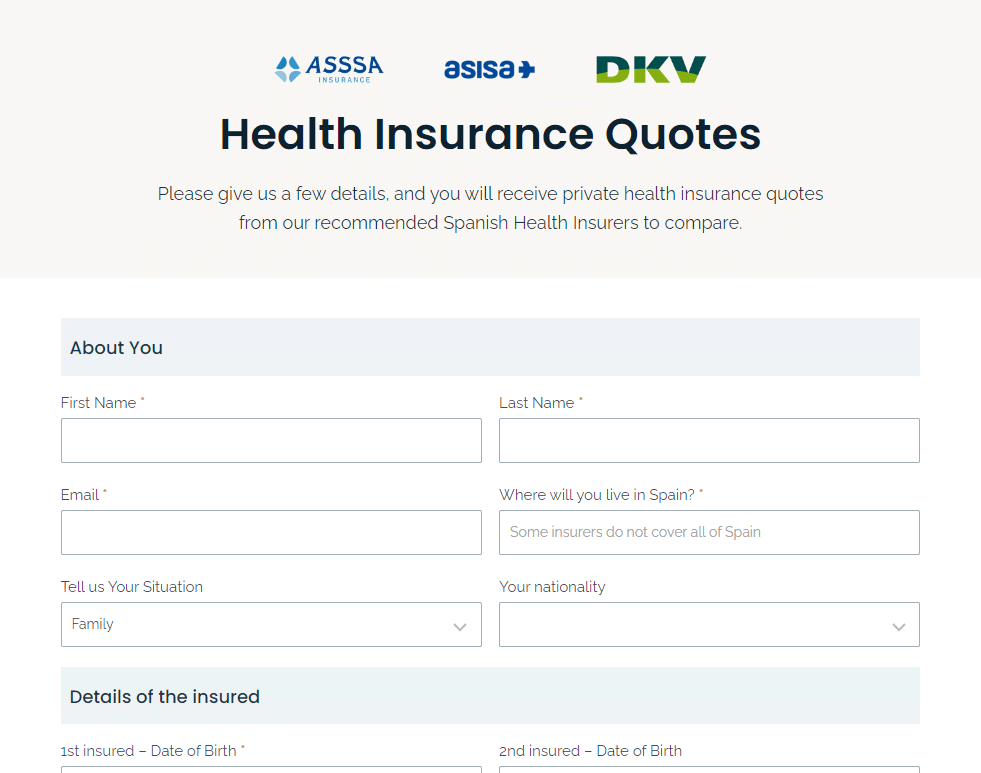
Our quote tool is designed to collect the information insurers typically need when assessing older applicants. This allows enquiries to be directed toward insurers that are actively open to applications from Expats over 75, rather than contacting providers that are unlikely to offer suitable cover.
We work with specialist partners who regularly handle Expat cases and monitor changes in insurer criteria. This makes it possible to place enquiries where they have a genuine chance of being assessed properly, rather than relying on broad or outdated assumptions about age limits.
Completing one short form allows your situation to be reviewed and, where appropriate, suitable options to be identified. If cover is available, you will receive clear information about what is on offer and how it fits your circumstances.
This approach helps you gain clarity early, reduce uncertainty, and decide how to proceed with the rest of your move to Spain without unnecessary pressure or rushed decisions.
What are the Common Things an Insurer Will Want to Know?
Before you request quotes, it helps to have a few basics to hand. Insurers assessing applicants over 75 will almost always ask for the same core information, and providing it upfront speeds up decisions and reduces back-and-forth.
- Your age and the date you want cover to start
- A current list of medications (name and dose)
- Any major diagnoses or treatment in the last five years
- Where you expect to live in Spain (so we can check local provider networks)
Being Over 75 Doesn’t Mean You Can’t Get Private Health Insurance in Spain
Moving to Spain is attractive for people of all ages. Many people worry about qualifying for visa and residency coverage, but for most, coverage is available. For most people over 75, suitable cover is still possible. The key is to start early, set realistic expectations, and seek help from people who understand how this market works.